top of page


THE JOURNAL
A DOCUMENTARY FILMMAKER'S BLOG
NEW YORK CHARLOTTESVILLE VALENCIA

FEATURE ESSAY
The numbers do not fully absorb. As of this writing, 1,783 cultural heritage sites have been damaged or destroyed in Ukraine since February 24, 2022. Among them, 46 have been completely erased. The Ministry of Culture counts 346 artists and 132 media workers dead. PEN Ukraine had already reached 102 cultural figures killed by the end of 2024, and the count has not stopped. These are not collateral casualties. They are the point.
Search


An Hour with Leon Botstein
Leon Botstein had agreed to sit before our camera earlier in the year, but a sequence of inconveniences pushed our meeting past the date we had set for the avant-première at the Century. When the interview finally happened, at his residence at Bard, he gave us not an answer but an essay — on Bristow, Dvořák, the modern piano, and the long, unfinished business of figuring out what America sounds like.

Eduardo Montes-Bradley
Apr 305 min read


Paul Chaleff and the Point of Transition
Robert C. Morgan visits Paul Chaleff's Pine Plains studio and finds a sculptor working the fault line where two dimensions become three — where a vessel becomes a sculpture, where function dissolves into form. A meditation on clay as a tactile counterweight to the digital fatigue of our age.
Eduardo Montes-Bradley
Apr 293 min read


Documentary Film Fund Is Proud to Support: The Voice Before the Silence — Norberto Ramírez and the Sonidos de Salta Sound Archive
Norberto Ramírez's Sonidos de Salta is one of Latin America's most significant oral heritage archives — a living sound bank documenting the writers, inhabitants, and landscapes of Argentina's northwest. A resource for academic institutions in ethnomusicology, musicology, and cultural anthropology.
Eduardo Montes-Bradley
Apr 295 min read
La Voz Antes del Silencio: Documentary Film Fund apoya la imprescindible labor de Norberto Ramírez y el Banco Sonoro de Salta
El Banco Sonoro de Salta, creado por Norberto Ramírez, es uno de los archivos de patrimonio oral más significativos de América Latina — un banco sonoro vivo que documenta escritores, pobladores y paisajes del noroeste argentino. Un recurso para instituciones académicas en etnomusicología, musicología y antropología cultural
Eduardo Montes-Bradley
Apr 295 min read


A Rooster, Two Musicians, and a Kitchen in Cuba. What Buena Vista Social Club Left Behind
Recorded in the back patio of a home in the barriada de Santa Amalia, municipio of Arroyo, this surviving fragment of the documentary project Son Tres Son captures two musicians, a rooster who refused to stay out of it, and the sounds of a kitchen preparing lunch. The song is Síctera Cubana, written by Carlos Enrique García Fernández, recorded in La Habana in 1994 by Trío Los Titanes. Some recordings capture a performance. This one captured an afternoon.
Eduardo Montes-Bradley
Apr 281 min read


Let's Face It, On Face/Off, John Woo, and the New Light That Original Work Casts on Ancient Myths
John Woo's Face/Off is a genuinely original piece of cinema. But originality is a more interesting thing than we usually give it credit for. The most original works are not the ones that arrive from nowhere — nothing arrives from nowhere — but the ones that cast a new light on myths and narrative tensions that have been traveling through human storytelling for centuries. That new light doesn't diminish what came before. It illuminates it.
Eduardo Montes-Bradley
Apr 276 min read


Daniel Chester French, The Piccirilli Factor, and George Bristow: An Unexpected Trilogy Across Art, Music, and Cultural History
How three documentaries — on Daniel Chester French, the Piccirilli Brothers, and George Frederick Bristow — became, almost by accident, a trilogy about the nineteenth-century American search for a cultural identity. A reflection on sculpture, music, authorship, and the long shadow of Massa-Carrara.
Eduardo Montes-Bradley
Apr 263 min read


The Last Brew: Astor Piazzolla and the Long Road to a Porteño Sound
You probably know Piazzolla from Adiós Nonino, or from the Kronos Quartet recording that made a generation of American listeners suddenly aware that something extraordinary had been happening in Buenos Aires for thirty years without their knowing. What is harder to explain is why it took so long — not for American audiences to discover him, but for Buenos Aires itself to accept what he had made.
Eduardo Montes-Bradley
Apr 2410 min read


The Soul of Stained Glass
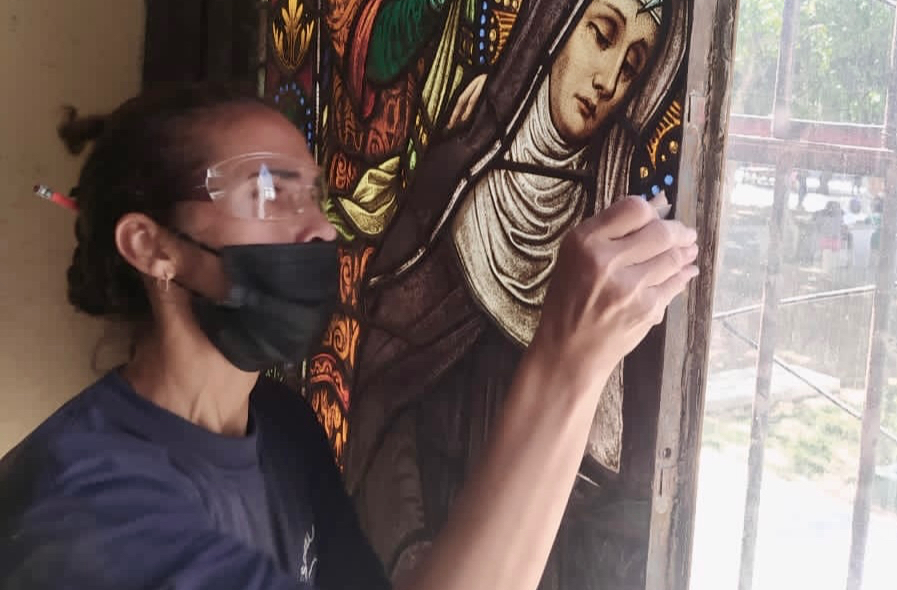
A stained glass window is a work of art — a dialogue between form, light, and color. Its fragility is comparable to human life, and yet like human beings it is capable of withstanding the assaults of time and oblivion. To preserve this heritage is to recognize where we come from and what road has brought us here.
Mirell Vázquez
Apr 232 min read


Alberto Laiseca at the Biblioteca Nacional
A 2004 film on Alberto Laiseca returns to Buenos Aires as part of a program at the Biblioteca Nacional, accompanied by a letter the writer sent after seeing the film—an extraordinary reflection that resists closure.
Eduardo Montes-Bradley
Apr 232 min read


Life and Music in the Age of George Frederick Bristow — Now Available Through Alexander Street / ProQuest
Life and Music in the Age of George Frederick Bristow soon to be release through Alexander Street / ProQuest, reaching universities, colleges, and public libraries worldwide. A 65-minute documentary about a composer New York forgot — and why that forgetting matters.
Eduardo Montes-Bradley
Apr 234 min read


Paul Chaleff: Form, Shape, Life — Notes for a Walk in the Park
Paul Chaleff occupies a position in contemporary American art that resists easy classification. Working in ceramics, yet rarely confined by the expectations of the medium, his work moves between object and sculpture, between function and form — propositions rather than tools — and into a philosophical territory rooted in existential inquiry.
Eduardo Montes-Bradley
Apr 223 min read

Willie DE - Lost and found treasures of Swannanoa
A forgotten roll of film shot near Charlottesville VA resurfaces, revealing a quiet collaboration with guitarist Willie De at the abandoned Swannanoa estate in the Blue Ridge Mountains.
Eduardo Montes-Bradley
Apr 221 min read


Romanian New Wave Film: A fost sau n-a fost? Released in the US as 12:08 East of Bucharest
A critical review of Corneliu Porumboiu's debut feature — a film about collective memory, the Romanian Revolution, and the provincial town that may or may not have been part of it.
Eduardo Montes-Bradley
Apr 214 min read


The Negro in the USSR: Four Books and an Unfinished Film
A filmmaker's shelf holds four books on one of the least documented chapters of twentieth-century American history: the African Americans — writers, engineers, artists, intellectuals — who traveled to or settled in the Soviet Union between the 1920s and the 1960s, in search of a society that promised what America denied them. Langston Hughes, W.E.B. Du Bois, Paul Robeson, and Robert Robinson. Before these books go into storage, they deserve a post.
Eduardo Montes-Bradley
Apr 194 min read


El alma de los vitrales
Un vitral es una obra de arte, un diálogo entre la forma, la luz y los colores. Testigo mudo de la historia, su fragilidad es comparable a la vida humana — y como ella, capaz de resistir los embates del tiempo y del olvido. Preservar este patrimonio es reconocer de dónde venimos.
Mirell Vázquez
Apr 192 min read


The Impossible Film
A filmmaker's response to Sergei Bondarchuk's War and Peace — the Soviet epic restored by Criterion and available now in its full four-part, seven-hour form. On spectacle, chaos, Pierre Bezukhov, and why nothing in the history of cinema quite compares.
Eduardo Montes-Bradley
Apr 184 min read


Victoria Ocampo: The Visionary Feminist Who Understood Women Better Than She Understood Mussolini
On my desk sits a first edition of Domingos en Hyde Park, published by Ediciones Sur, Buenos Aires, 1936. On the flyleaf, in a confident cursive hand: "A R. E. Montes Bradley, con toda simpatía — Victoria Ocampo." The essay it introduces — La Historia Viva — is one of the most remarkable political documents written by a Latin American intellectual in the twentieth century. It is remarkable not because Ocampo admired Mussolini. Many did. Between 1921 and 1935, Franklin D. Roos
Eduardo Montes-Bradley
Apr 1815 min read
bottom of page