


Let's Face It, On Face/Off, John Woo, and the New Light That Original Work Casts on Ancient Myths
Updated: May 4
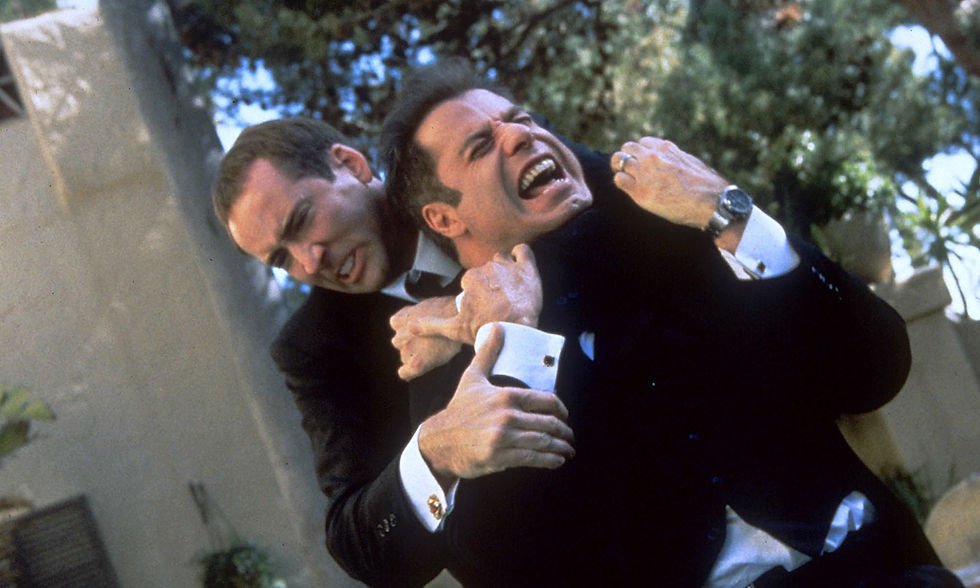
You probably left the theater thinking you had seen something completely new. And you had. I watched John Woo's Face/Off last night at the Alamo Drafthouse — the 1997 film in which a federal agent and a terrorist surgically exchange faces and are forced to inhabit each other's lives, families, and identities — and the astonishment it produces nearly thirty years after its release is entirely earned. The conceit remains audacious. The emotional architecture, operatic and relentless, holds completely.
But originality is a more interesting thing than we usually give it credit for. The most original works are not the ones that arrive from nowhere — nothing arrives from nowhere — but the ones that cast a new light on myths and narrative tensions that have been traveling through human storytelling for centuries. That new light doesn't diminish what came before. It illuminates it. And what Face/Off illuminates, once you begin to look, turns out to be very old indeed.

The Face as the Self
The central proposition of the film — that exchanging faces means exchanging identities, that the face is not a surface but the place where the self lives and is vulnerable — is where Woo's originality is most fully his own. Previous versions of this story, and there are many, worked around that idea metaphorically. Woo makes it literal, physical. The surgery is not a plot device. It is a philosophical statement: you are your face. Take it away, and you take everything.
This is what the film adds to the tradition it inherits. Not the ancient identity switch. Not the impostor in the marriage bed, which goes back to the Greeks. Not the doubled self, which Dostoevsky and Poe and Borges all explored with extraordinary precision. What Woo adds is the corporeal literalism — the scalpel, the transfer table, the moment when one man looks in the mirror and sees his enemy looking back — that makes all of those inherited anxieties suddenly, unbearably concrete.
In casting that light, he reveals something in the old material that was always there but never quite visible: that every previous version of the identity exchange story was circling the face without quite daring to make it the center. Plautus knew that Zeus taking Amphitryon's form meant taking his face. Shakespeare knew it. The writers of The Return of Martin Guerre knew it. But none of them had the cinematic means — or perhaps the particular cultural moment — to put the face itself on the operating table and make it the explicit site of the drama. Woo did.
The Clay That Was Already There
The identity switch at the heart of Face/Off is as old as Western literature. Zeus, in the myth of Amphitryon, takes the exact form of a husband to sleep with his wife Alcmene — a story that Plautus told, Molière retold, and Heinrich von Kleist made into one of the most unsettling comedies in the German language. The mechanism is identical to Woo's in every respect but the surgical one: an impostor occupies a man's place so completely that those closest to him cannot tell the difference. The question the myth poses — if your face, your voice, your body are indistinguishable from mine, what exactly do you mean when you say you are you — is the same question Face/Off poses. Woo simply found a new and more violent way to ask it.
The impostor in the marriage bed has its own distinguished lineage. The Return of Martin Guerre — based on a true case from sixteenth-century France in which an impostor lived for years as a missing husband, sleeping with his wife, raising his children, managing his farm — was made into a celebrated French film in 1982 and an American remake, Sommersby, in 1993, four years before Face/Off. The question both films circle — did the wife know, and if she knew, was her acceptance a betrayal or an act of love — reappears in Face/Off with new intensity. The villain living inside the hero's face, inside his house, inside his marriage, discovers something he did not expect: that tenderness is not a performance. It lives in the life, not in the face. The new light Woo casts on the Martin Guerre story is precisely this — that the impostor may be transformed by what he finds in the life he has stolen.
The doppelgänger — the double who threatens to displace the original — runs from Dostoevsky's novella The Double(1846) through Poe's William Wilson, through Bergman's Persona (1966), in which two women's identities dissolve into each other until neither the characters nor the audience can say with confidence where one ends and the other begins, through Cronenberg's Dead Ringers (1988), in which twin gynecologists trade places with increasingly pathological consequences. Each of these works illuminated something the previous ones had left in shadow. Face/Off continues that chain. What it illuminates that Dead Ringers — its most immediate cinematic ancestor — did not is the moral symmetry of the exchange: both men are changed, and changed equally, and what changes them is not the face they wear but the life they are forced to inhabit behind it.
The Lawman and the Criminal
The deepest current in Face/Off connects it to the oldest moral question in the crime and western genres: are the lawman and the criminal the same person at the core, separated only by which side of a line they happened to land on? Fritz Lang asked this in M in 1931. Robert Louis Stevenson asked it in Jekyll and Hyde in 1886. Sam Peckinpah spent his entire career asking it in the American west. The genre is built almost entirely on the mirror relationship between the hunter and the hunted, the badge and the gun.
What Face/Off does with this inherited tension is make it not just moral but experiential. The two men do not merely resemble each other in their capacity for violence or their hunger for order. They become each other. They live each other's lives. The hero discovers the seductiveness of the villain's freedom. The villain discovers the weight of the hero's love and grief. Neither can return to what he was before the exchange. The new light Woo casts on the Lang and Stevenson tradition is the irreversibility: the mirror, once you have stepped through it, does not let you back.
What Woo Made
None of this is to say that Face/Off is a film about its sources. It is not. It is a film about two men, a face, a family, and the violence of identity — and it works entirely on those terms, for an audience that has never heard of Amphitryon or Martin Guerre or Dostoevsky's civil servant. The myths it carries do their work invisibly, the way myths always do, generating emotional resonance whose origins the audience cannot name but whose force they feel completely.
That is what original work does within a tradition. It does not replace what came before. It does not borrow from what came before in the sense of taking something that belonged to someone else. It receives what the tradition has accumulated — all that anxiety about identity, about the face, about the double, about the lawman and the criminal — and finds a new form that makes it visible again, freshly, as if for the first time.
Borges argued that the strong work changes not only the future but the past — that after Kafka, we read his precursors differently, that the successor illuminates the precursor rather than descending from it. Face/Off does something of this kind to the Amphitryon tradition, to the Martin Guerre tradition, to the Jekyll and Hyde tradition. After watching Woo's film, you watch those older versions with new eyes. You see what they were reaching toward. You see the face on the operating table that none of them quite had the means to show. And that, in on itself, is original.
The screenwriters Mike Webb and Michael Colleary built this particular version of a story that has been told since human beings first sat around a fire and asked the question that still has no fully satisfying answer: how do I know that you are you? John Woo found the image that makes the question impossible to look away from. That is enough. That is everything.


Comments