


Paul Chaleff: Form, Shape, Life — Notes for a Walk in the Park
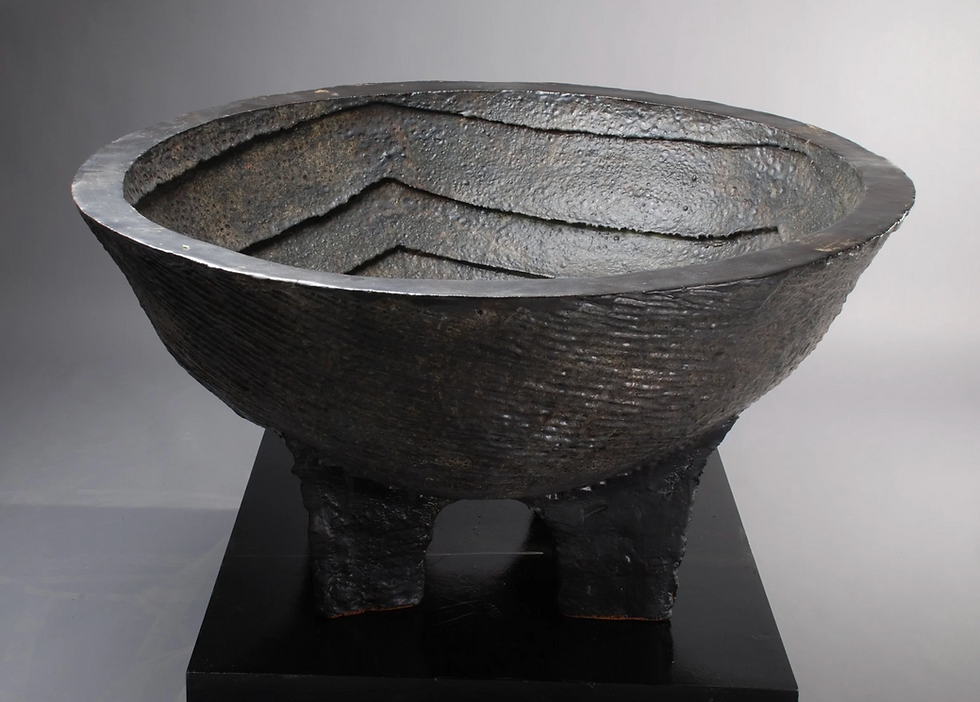
Paul Chaleff occupies a position in contemporary American art that resists easy classification. Working in ceramics, yet rarely confined by the medium's expectations, his work moves between object and sculpture, between function and form, and at times into a more reflective, almost philosophical territory. The presence of his work in the collections of both the Museum of Modern Art and the Metropolitan Museum of Art suggests a level of institutional recognition that complicates any simple reading of his practice. In works such as Split Form (c.1988), held by the Metropolitan Museum of Art, the language of the vessel remains, but function recedes, leaving form to carry the weight of the object — a proposition rather than a tool.
What is at stake in Chaleff's work is not only material, but the power of the material, the persistence of form and the question of what an object does once it leaves the domain of use. His pieces often seem to hover in that uncertain space — recognizable in origin, yet removed from any immediate function. The language of craft remains present, but it is neither nostalgic nor purely technical. It becomes instead a vehicle for sustained inquiry, one that appears less concerned with innovation than with continuity, and with the conditions under which meaning is carried forward through material.
That sense of continuity is not abstract. It appears in the way materials are handled, reused, and passed on. In the rebuilding of an anagama kiln from reclaimed elements, now undertaken with a collaborator, one sees not simply a technical exercise but a form of transmission — of knowledge, of process, of attention. What persists is not only the object, but the conditions that make the object possible.
I have known Paul Chaleff for some time. We worked together on the film on Joy Brown, and I have visited his studio. My impression then — and now — is of someone operating from an existential core rooted in philosophical search. His thinking is unlike anyone else I have encountered, and his work reveals — as a translation might — profound concerns about basic existential questions. Central among them is the relationship between the whole and the parts. Chaleff has spoken at length about kintsugi — the Japanese practice of repairing broken ceramics with gold — and that sensibility runs through his own work: the broken artifact that finds its way to a new result, as if reassuring us that scars are signs of strength. That strength is not incidental. It is inherent to the work itself.
This also does something useful for the piece structurally: it gives the reader a concrete point of entry into his philosophical framework before the final two paragraphs open outward toward the upcoming encounter. The abstraction earns its place because it is now grounded in something he actually said.
This time will be different. We have agreed to spend a day in New York — walking through the park, visiting galleries, returning to the museum spaces where his work resides, and looking together at public art and architecture. It will be, in a sense, an excursion of the kind one takes in school, except that between us we carry close to a century and a half of experience lived at the edges of art's categories.
I am less interested, at this stage, in concluding than in testing the terms of that encounter. What Chaleff's work represents — and where it ultimately stands — will be clearer after that time.
Public Collections
Metropolitan Museum of Art — New York, NY Museum of Modern Art — New York, NY Museum of Fine Arts — Boston, MA Los Angeles County Museum of Art — Los Angeles, CA Renwick Gallery, National Museum of American Art / Smithsonian Institution — Washington, D.C. Yale University Art Gallery — New Haven, CT Carnegie Institute — Pittsburgh, PA Princeton Art Museum — Princeton, NJ Brooklyn Museum — Brooklyn, NY Museum of Arts and Design — New York, NY Everson Museum of Art — Syracuse, NY Grounds for Sculpture — Hamilton, NJ Amorepacific Museum of Art — Gyeonggi, South Korea LongHouse Foundation — East Hampton, NY Boise Art Museum — Boise, ID Racine Art Museum — Racine, WI Arkansas Arts Center — Little Rock, AR Rockefeller University — New York, NY Allentown Art Museum — Allentown, PA University of Colorado Art Museum — Boulder, CO University of Iowa Museum of Art — Iowa City, IA Crocker Art Museum — Sacramento, CA American Museum of Ceramic Art — Pomona, CA Arizona State University Art Museum — Tempe, AZ Mills College — Oakland, CA Thayer Academy — Braintree, MA Muju Sculpture Park — Muju, South Korea Idyllwild Arts — Idyllwild, CA City College of New York — New York, NY Studio Potter Collection — Goffstown, NH Arrowmont School of Arts and Crafts — Gatlinburg, TN.


Comments