


Héctor Tizón: The Journey as Destiny
Updated: Jun 16
There are writers whose work cannot be separated from the land that produced them. Héctor Tizón is one of those rare figures — a novelist, short story writer, and judge from the province of Jujuy whose prose carries the red earth, the clashing rivers, and the layered silences of the Argentine Northwest as though the landscape itself had learned to speak through him. Our documentary, filmed entirely in Jujuy, was and remains an attempt to listen.
Born from a Conversation
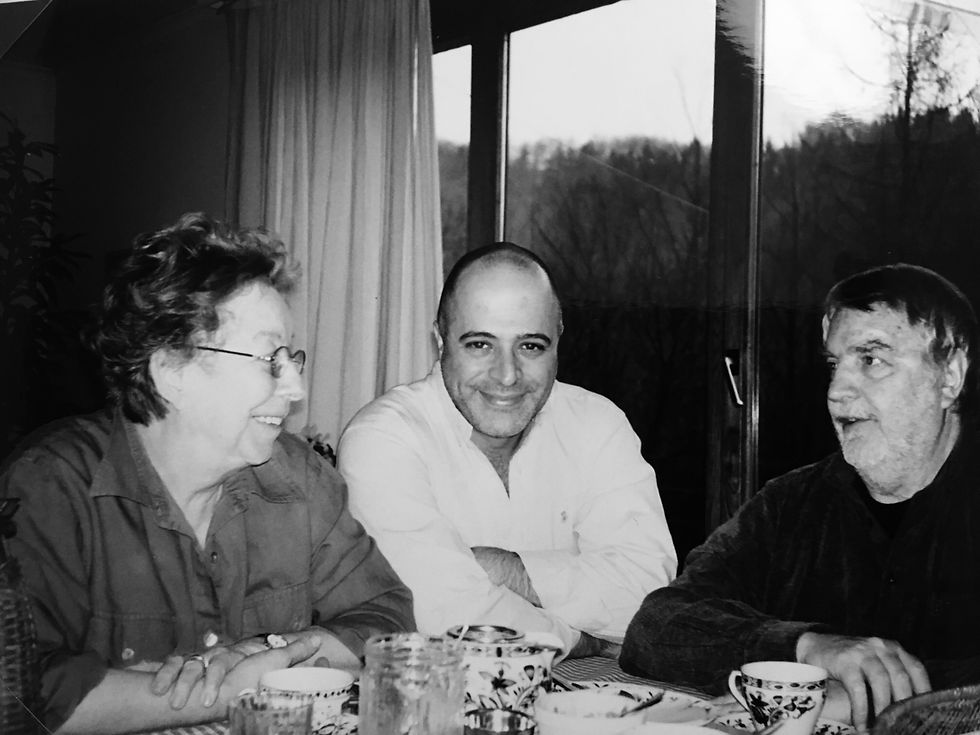
The film grew out of something deceptively simple: a conversation with Tizón. What emerged was not an interview in the conventional sense but a meditation — wide-ranging, unhurried, and structurally faithful to the way Tizón himself thinks, which is to say: associatively, mythically, with one story always opening onto another.
The camera stays close to the writer and to Jujuy. There are no studio backdrops, no staged re-enactments. The province is not background — it is argument.
The Journey as the Essential Human Metaphor
At the heart of what Tizón offers in this film is a meditation on displacement as the defining condition of human existence. The journey, he suggests, is not merely something that happens to people. It is the structure of a life.
He arrives at this through a remarkable anecdote: the story of his grandfather, a Spanish military man who was posted to Cuba during the war of 1898 and who, as a young man, had his first vision of tropical landscape — palms, heat, a world saturated with color. When Spain lost the war and the regiment returned home, the grandfather carried that Cuban image for the rest of his life, the way, Tizón observes, we all carry the first landscape our eyes truly saw.
Years later, looking to emigrate, the grandfather boarded a ship in Vigo bound for what he imagined was the same tropical world. He arrived instead at the Río de la Plata — a gray estuary, flat horizon, no palms. Someone told him: go north. Two days and two nights by train, and you will find what you are looking for.
He did. He became one of the founding families of the province, one of the first banana planters in the region. He married, had many children, and then one day — disappeared. No explanation. By order of his widow, his name was never spoken again. "And of course," Tizón says, "precisely because of that, we kept asking about him. We still ask."
The story contains everything Tizón writes about: migration, reinvention, erasure, memory, the family secret that becomes the deepest inheritance.
When Puccini Almost Came to Jujuy
With characteristic delight in the unlikely, Tizón recalls an episode involving Giacomo Puccini — not the famous composer himself but his brother, who had come to Jujuy fleeing yellow fever in Buenos Aires and was earning a modest living teaching piano to the ladies of the province. The composer, already famous in Europe after the successful premieres of his early operas, wrote to his brother urging him to save money so that he, Giacomo, might come to live there.
The brother began to have second thoughts. His responding letters discourage the plan. In one, he warns: this land is full of lawyers and notaries and everyone sues everyone else over everything. In another, he cautions that the territory is full of red-skins — by which Puccini, in the parlance of his era, would have meant the indigenous Coya and Andean peoples of the region.
Tizón tells the story without moralizing. What fascinates him is simply the improbability of it: that one of the most celebrated composers in Europe once genuinely considered settling in this remote Andean province. The gravitational pull of somewhere else — the desire to go, to begin again — operates on the famous and obscure alike. It is, Tizón suggests, one of the great engines of human life.
Where the Rivers Meet: Cultural Hybridity in the Andes
The film finds one of its most sustained and beautiful passages in Tizón's description of a spot near the village of Yala, where two rivers converge: the Río de Yala, fed by mountain springs and running clear, and the Río Grande, heavy with sediment from its long descent, turbid and dark. For a stretch of several kilometers the two rivers run side by side without mixing. Then, slowly, the dark water prevails. The clarity becomes milky, the milky becomes turbid, and the Río Grande absorbs the other entirely.
It is, Tizón says, a little of what happens in all other aspects of life in these places — in religion, in language, in memory. The cultures that converged here — Andean indigenous civilization, Spanish colonialism, European immigration — did not blend instantly or cleanly. They ran alongside each other for a long time. One eventually gained the upper hand. But the traces of what was absorbed remain, if you know how to look.
His own upbringing is the living proof. His nurses — his niñeras — spoke Quechua or a heavily Quechua-inflected Spanish. The first stories he was told, the first cosmology he absorbed, was Andean: the gods live in the earth and beneath the earth, not in the sky. When Catholic catechism arrived and told him God was in heaven, the contradiction was real and lasting.
"For a long time," he says, "I had no idea which was true."
The Myth That Needs No Explanation
There is a scene Tizón recounts in which his wife, researching the figure of the devil in the oral traditions of Northern Argentina, travels to a remote village and speaks with an elderly man who describes a monster in a nearby cave — horned, goat-footed, living in a labyrinth from which no one returns alive. One survivor escaped, the man says, because he had the foresight to leave a trail of crumbs from the bread in his pocket.
When Tizón's wife mentioned Theseus and the Minotaur, and Hansel and Gretel, the old man looked at her with mild irritation. "Of course," he said. "Many foreigners come here and copy our stories and publish them as their own."
Tizón tells it as a perfect joke, but the point beneath the laughter is serious. The great myths travel. They embed themselves in specific landscapes and emerge as local truth. They require no attribution because they belong to everyone and no one. "That is the function of myth," Tizón says. "And also, deeply, of fiction."
A myth that needs explanation, he adds, is a dead myth. A living myth explains itself.
Language as Home
Perhaps nowhere is Tizón more impassioned than in his defense of the regional Spanish of the Northwest — not as a folkloric curiosity to be preserved in amber, but as a living, precise, and philosophically richer instrument than the standardized Spanish of Buenos Aires or Madrid.
He offers an example. In Jujuy and the surrounding region, the verb used for waking up is not despertar but recordar — to remember. One does not simply cease sleeping. One returns to oneself, to one's memory, to one's capacity to think. Recordar carries far more weight than despertar. It suggests that consciousness is a form of self-recovery.
When Tizón uses such words in manuscripts, publishers' copy editors mark them as errors. He returns the proofs with explanatory notes. The battle is constant.
It is also, he makes clear, a battle with stakes beyond style. The homogenization of language through media and market — what he calls a neolengua, a new-speak — is not simply an aesthetic impoverishment. It is the gradual erasure of ways of knowing, ways of experiencing time, memory, and relationship that took centuries to form. Literature, for Tizón, is one of the few spaces where that erasure can be resisted — not through nationalist performance, not through the deployment of picturesque regional markers to signal authenticity, but through the deeper, quieter work of listening carefully to how a place actually speaks and rendering that listening into prose.
Against the Picturesque
This brings Tizón to one of his most pointed arguments, one that speaks directly to the craft of any writer working from a specific place: the danger of the picturesque.
Local color, he warns, is the refuge of the writer who has nothing to say. A gaucho dancing, a Coya figure with his chuspaand kena — these markers of regional identity are chafalonia, trinkets, the literary equivalent of a souvenir. What makes a work local is not the costumes it wears but the depth at which it registers the experience of a particular human community. Shakespeare could set his plays in Venice, in Elsinore, in ancient Rome, and the result was not travelogue but revelation. But Shakespeare, Tizón adds with a wry smile, had to be Shakespeare to get away with that.
For the rest of us, the obligation is more humble and more exacting: to listen, to render faithfully what we hear without transcribing it mechanically, and to trust that the specific, rendered with honesty, contains the universal.
Writing by Necessity
The film draws to a close around a question Tizón has spent his career answering with his work rather than his declarations: must literature be committed? Must it serve a cause?
His answer is characteristic in its refusal of easy positions. He does not believe in uncommitted art — all genuine literature is, at some level, a moral act. But he is equally skeptical of militancy, of the ideological instrumentalization of fiction. The most forgettable pages of the greatest writers, he observes, are often those written in service of a cause — Victor Hugo, Neruda, and others committed to specific ideological programs produced work in those moments that their own admirers quietly skip.
The distinction is subtle but essential: writing by necessity versus writing by assignment. The first comes from something that must be expressed because it cannot be held inside any longer. The second comes from a decision to be useful to a position. The first produces literature. The second, at its best, produces pamphlets.
The Train That No Longer Passes
Among the recurring images in the film is the railway — or rather, its absence. Tizón speaks of the trains that once connected Jujuy to the rest of the country, the tracks that ran alongside the lives he grew up near, the sensation of possibility that the arriving train carried with it. The last train passed through in 1991, when the Argentine government dismantled the national rail network, leaving what Tizón calls an archipelago — a country of islands, incommunicado.
The trains were not merely transportation. They were metaphor. They were the concretization of the journey — that "great motor of life" — in iron and steam and schedule. Their disappearance was not only logistical but existential: another of the erasures that Province endures, another removal of connection and movement.
And yet the people of the region continue to travel. The puna dwellers, those seemingly most rooted to a single landscape, are in fact in constant motion — going to market, visiting lawyers (a surprisingly important figure in Tizón's account of provincial life), going for no reason at all except that movement is what people do.
"I didn't go to arrive," an old writer friend of Tizón's once said of a journey in a battered car on a doubtful road. "I went to go."
A Return to Home
At the end of the film, Tizón returns to where he always returns: to the idea that all traveling is, finally, the long way home.
He has lived in Mexico. He has been in exile. He has traveled through Europe and South America. But Jujuy is the place to which he has always come back — not with resignation but with recognition. The man who circles and circles, he says, learns eventually where he will finally rest.
It is not a melancholy thought in his telling. It is a statement of form: a life has a shape, and the shape, if you live long enough to see it whole, turns out to be something like a circle.
This documentary is our attempt to walk part of that circle with him.
Héctor Tizón was filmed entirely in the province of Jujuy, Argentina. A Heritage Film Project production directed by Eduardo Montes-Bradley and Soledad Liendo.


Comments