Search Results
460 results found with an empty search
- BLACK FIDDLERS New Exhibit
ALEXANDER BLACK HOUSE New exhibit at Alexander Black House looks at African influence on regional music Thursday, Nov. 10, 6 to 7 p.m. — “Black Fiddlers” documentary screening. “Black Fiddlers” traces the personal and family stories of violin players of African descent in New York, North Carolina, Ohio, Virginia, Texas, Missouri, and as far as Oregon during the Indian Wars and the Gold Rush. Inspired by the legacy of Joe and Odell Thomson, director Eduardo Montes-Bradley reached out to musicians Rhiannon Giddens and Justin Robinson from The Carolina Chocolate Drops, and old-time fiddler Earl White, to reconstruct 300 years of Black music with the help of local historians, academics, and award-winning authors like Kip Lornell and John J. Sullivan. Learn more at
- NEW MURAL AND FILM
Join us! November 11-13, 11-5 pm and by appointment through Nov 16th Reception: Saturday, November 12, 4-7 pm Kent Green, 4 Landmark Lane, Kent CT Presentation: 5:30 | Eduardo Montes-Bradley, acclaimed documentary film maker, will talk about and present footage of the film being made about this mural. The Mural For over two years I’ve been working on a 50-foot ceramic mural for the permanent collection of a new art museum on Amami Island in Japan, built by my lifelong friend Shin Watari. It’s a project near and dear to my heart! The Horokan museum (meaning “to wander”) is dedicated to the children of Shin’s hometown. He proposed the theme of the mural -- One World -- inspired by the international spirit of the continuing friendships of our high school class in Japan, while reflecting Shin’s way of life and support of art. From the original sketches and carving in clay to the firing in my Japanese style wood-firing kiln here in Kent, the mural is now complete! I would be thrilled for you to join us to celebrate and see the whole mural before it heads to its new home in Japan. The Film Eduardo Montes-Bradley is making a film about the artistic and spiritual journey of the mural from its inspiration to the installation in Japan, including the continuing thread of east and west in my life and work and in our community, created through the love, magic and joy in art. See these two beautiful outTakes Eduardo made of the firing and studio this summer. We need your help to make this film! If you’d like to contribute or learn more, go to Documentary Film Fund, docfilmfund.org
- DEIRA LOST & FOUND
The series of seven impressive paintings by Ernesto Deira were restituted to his family in Buenos Aires after fifty years. Buenos Aires was a unique place to meet with the artist that gathered around the family dinner table to celebrate my mother’s cooking, and my father’s affability. He was a music editor, and a good storyteller, she was a patron of the arts, and a gifted host. Amongst my parents’ close friends were Olga “Lucy” Galperin, and Ernesto Deira. She is a distinguished pianist; he was a famed artist who pioneered the New Figuration in Latin America. After the military coup of 1976, Lucy and Ernesto went into exile in Paris where, over many years I developed a close friendship with their son Martin. Ernesto died in 1986, and twenty years later the Museum of Fine Arts of Buenos Aires curated a retrospective of his work for which Martin and I created a short biographical film about his father. Almost twenty years, we’re once again sited at the same table, wearing our thinking hats. The reason behind this challenge is a set of seven paintings by Deira known collectively as “Identifications”, which were lost in Chile after the Pinochet's power grab in 1973. The paintings, of strong political and social content, were believed to have been destroyed by the military dictatorship. Deira died in exile believing his work was irremediably lost. However, in 2003, during a visit to Chile, Felipe Noé, Deira’s old friend and fellow artist, learned the paintings had been preserved in storage at the Museum of Contemporary Art in Santiago. During the next twenty years, Deira’s family struggled for the immediate restitution of the seven paintings of the series known as “Identificaciones”. In October of 2021, an agreement was finally reach and a month later the paintings were restituted to artist family in Buenos Aires.
- JULIAN BOND
REFLECTIONS FROM THE FRONTLINES OF THE CIVIL RIGHTS MOVEMENT 2012 | 33min | Available from Kanopy African American social activist Julian Bond tells his family's story: a struggle for equality. Tracing his roots back to slavery, Bond recounts the family's tradition of hard work and an emphasis on education as a means for advancement. Using historical film footage and still photographs, a female voice speaking as Bond's mother, and scenes of Bond lecturing in his classroom at the University of Virginia, he reviews his participation in the Student Non-Violent Coordinating Committee (SNCC), his role at the 1963 March on Washington, his service in the Georgia House and Senate, his nomination for the vice presidency of the United States at the 1968 Democratic Convention, his protest of the Vietnam War, and his praise for President Lyndon Johnson's actions towards civil rights. Bond leaves viewers with a look forward—"So many undone things in this country"—and his firm belief that someone will step forward to lead the way. The centerpiece of the film is Bond talking to an off-screen interviewer—it is powerful. American history, African American studies, and government classes can utilize this film to review history from a primary source. The film's length makes it very classroom friendly.—Patricia Ann Owens
- Black Fiddlers to Screen at VFF
The 35th edition of the Virginia Film Festival will screen Black Fiddler by Eduardo Montes-Bradley as part of the "Black Excellence Series". Black Fiddlers – Charlottesville-based filmmaker Eduardo Montes-Bradley returns to the VAFF with a documentary that explores the legacy of African Americans who have made important contributions to American folklore, tracing the personal stories of violin players of African descent ranging from here in Virginia to as far away as Oregon. The screening features a conversation with and performance by film subject Earl White. The screening is supported by 101 Jamz and Minority Business Alliance of the Charlottesville Regional Chamber of Commerce. For tickets and program informarion, please visit https://virginiafilmfestival.org/
- A Vancouver Premiere
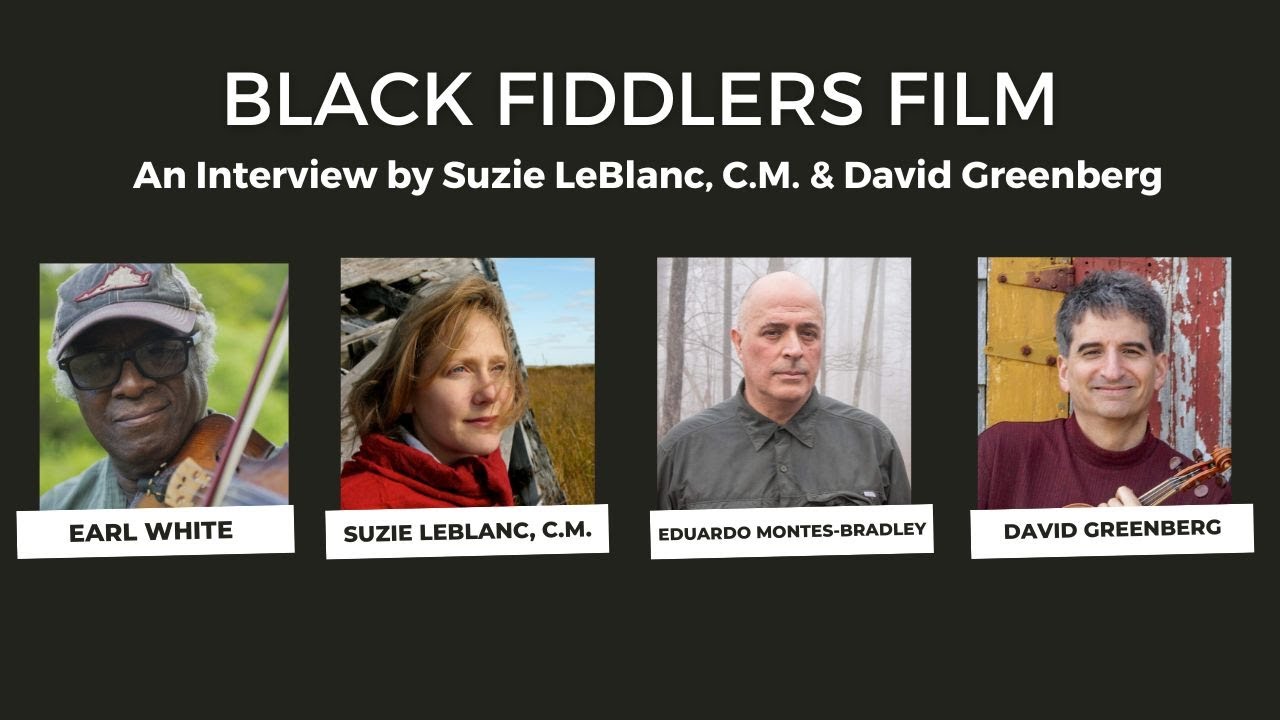
Enjoy this interview with Back Fiddlers Creator Eduardo Montes-Bradley and featured fiddler Earl White as they discuss their film and the history of black fiddlers. Hosted by Suzie LeBlanc, C.M. and one of EMV's Artists-In-Residence, David Greenberg, this interview is a delight for all who want to learn more about back fiddling culture. Directed by Eduardo Montes-Bradley, the film traces the personal and family stories of violin players of African descent in New York, North Carolina, Ohio, Virginia, Texas, Missouri, and as far as Oregon during the Indian Wars and the Gold Rush. Inspired by the legacy of Joe & Odell Thomson, director Montes-Bradley resorted to performers Rhiannon Giddens and Justin Robinson from The Carolina Chocolate Drops, and old-time fiddler Earl White to reconstruct three-hundred years of Black music with the help of local historians, academics, and award-winning authors like Kip Lornell and John J. Sullivan. Black Fiddlers is the result of one year of uninterrupted research, on the road and on location. The result is a compelling one-hour documentary film carefully designed to inform and entertain while presenting the audience with a diversity of arguments never explored before on film.
- The Other Madisons
Gratification doesn’t always come easy with regards to the performance of one’s own projects in festivals. Nevertheless, I admit I was completely wrong in my initial expectations for “The Other Madisons”. Was I underestimating our work, the joint effort of having worked with Bettye Kearse during the production and execution of this documentary film? But the overwhelming result it’s been a breeze of fresh air and recognition for the original story, and the film. It feels good to see all the laurels lineup, and although I’m certain “The Other Madisons” will continue to bring us the recognition the ancestors deserve, I will take a break today to celebrate the already conquered trophies. Thank you Mystic, Martha’s Vineyard, Black Truth, Roxbury, DC Black Film Festival, and Atlanta for the love and support.
- Child of the forest
In the testimony Holocaust survivor Yona Bromberg gave to Eduardo Montes-Bradley, she recalls being herded to the market along with all other Jews in Rokitna. Soon thereafter, the SS surrounded the market with soldiers and machine guns. Suddenly someone yelled "Run Jews, run, they are going to kill us" and those who could flee towards the woods. "My brother and father weren't as lucky as my mother, my sister and me; they were killed, and we survived in the woods for eighteen months until Liberation.” From the United States Holocaust Memorial Museum film library.
- The Tragedy of Novelli
James Novelli was born in Sulmona, ancient village east of Rome best know as the birthplace of Ovid, and also home to Edmondo Quattrocchi, the Italian-American sculptor who collaborated with Frederick MacMonnies using a pointing maching of his own device. Novelli’s legacy had almost faded by the time Josephine Murphy, Novelli’s ad-hoc biographer and archivist, began her research and preserve his work. Josephine is now collaborating with me on “The Italian Factor”, a film about the many contributions of Italian artisans in times of the American Renascence and beyond. According to Josephine, James (b. Salvatore) arrived in New York when he was five years old. The family almost immediately settled on a five-story high tenement on Mulberry St., just across Columbus park, a neighbourhood notorious for its appalling living conditions, crime, poverty, and diseases. James attended the recently inaugurated school in the area were many of the children went barefoot. During recess, the girls would dance in the street at the tune of the barrel organ. Today, that section on Mulberry St. below Canal is part of Chinatown and, at first glance, seems hard to find evidence of what was once the heart of Little Italy. Nevertheless, if one is to look carefuly, the evidence will reveal itself when least expected. New York’s Little Italy Described In 1898 "Mulberry St., here at its southern end, is narrow, dark, and dirty. Six-story tenements, whose unwashed windows scarcely disclose any evidence of the lamp-light within, rise in a solid wall on either hand. Their first floors are occupied by shops of various kinds—all dark now, but blurs of red and yellow light at each corner, and once or twice in the middle, of every block, show that the saloons are still open. Along the curbstone, every two or three doors, are groups of trucks, whose drivers and horses are stabled somewhere in the midst of these tenements. It is not much after ten o’clock, and plenty of people are in the street; if it be one of the hot summer evenings, everybody is out, half of them asleep on the trucks, or in door-steps, or on the cellar doors, where the mothers have brought pillows, or maybe a mattress, for their children to lie upon; and there they will sleep all night rather than stifle inside those awful hives of neglected humanity.” Source: Studdnobodycaresabout.com Acording to Josephine, it was by a stroke of good-luck that James was discovered while drawing with chalk on the sidewalk. His benefactor, whos’ name remains in the shadows, will help James to pursue an art education in Rome, an ambition that was otherwise out of reach to the son of a sweatshop seamstress, and a garbage collector. In Rome, Novelli had the opportunity to study with Gulio Monteverde, Ettore Ferrary and other distinguished sculptors of the Italian academia. Occasionally, perhaps on long weekends, James traveled to Sulmona where he once modeled a bust of his grandmother, now unfortunately lost, although a photograph is conserved on the archives of the Smithsonian. Throught his life, Novelli’s ethos gravitated between the example of his grandmother, the Italian upbringing, the sacrifice of his parents, and the example of Abraham Licoln, who he regarded as a role model of civil virtues. For most of his life Novelli struggled between commissions for memorials celebrating political figures, and monuments to heroes from the Great War, and his bass-reliefs for mausoleums celebrate the elegance of art-nouveau with particularly distinction. By mid’1930s Novelli´s footprints begin to fade. He´s name was dropped from the membership of the National Sculpture Society, and for a while he worked employes by The Public Works of Art Project in the maintenance and restauration of monuments, including his own, but in 1936 Novelli he filed for unemployment, and shortly thereafter he gave up his atelier-studio on West 23rd street. Then, the trail goes cold... Four years later, sadden by the war between Italy and the United Stetes, and distressed by economic hardships James Novelly hanged himself in his apartment in Jackson Hights. He was 54 years old.
- Black Fiddlers, nominated
Black Fiddlers, a documentary film exploring the legacy of African Americans who contributed to shaping the cultural landscape of American folklore has been nominated to compete at D.C. Black Film Festival 2022. This is the second consecutive time that a film by Eduardo Montes-Bradley, and produced by Heritage Film Project is selected by the prestigious festival in Washington. Black Fiddler traces the personal and family stories of violin players of African descent in New York, North Carolina, Ohio, Virginia, Texas, Missouri, and as far as Oregon during the Indian Wars and the Gold Rush. Inspired by the legacy of Joe & Odell Thomson, director Montes-Bradley resorted to performers Rhiannon Giddens and Justin Robinson from The Carolina Chocolate Drops, and old-time fiddler Earl White to reconstruct three-hundred years of Black music with the help of local historians, academics, and award-winning authors like Kip Lornell and John J. Sullivan. Black Fiddlers is the result of one year of uninterrupted research, on the road and on location. The result is a compelling one-hour documentary film carefully designed to inform and entertain while presenting the audience with a diversity of arguments never explored before on film.