


Totems Without Theology
Walking with Paul Chaleff through the Hudson Valley's lost civilization to come
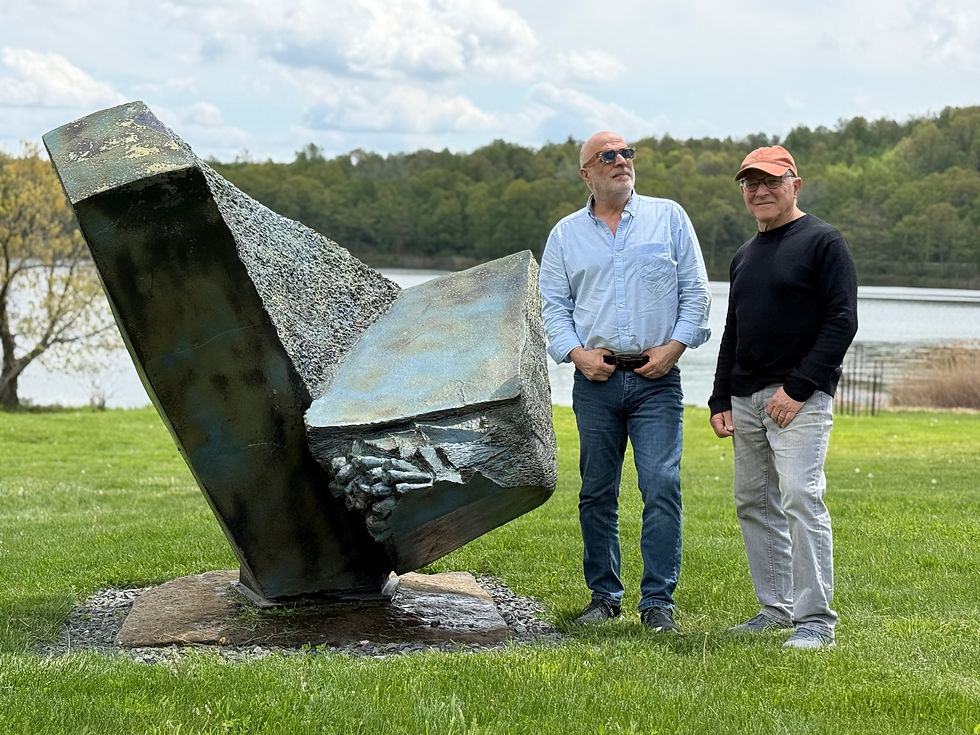
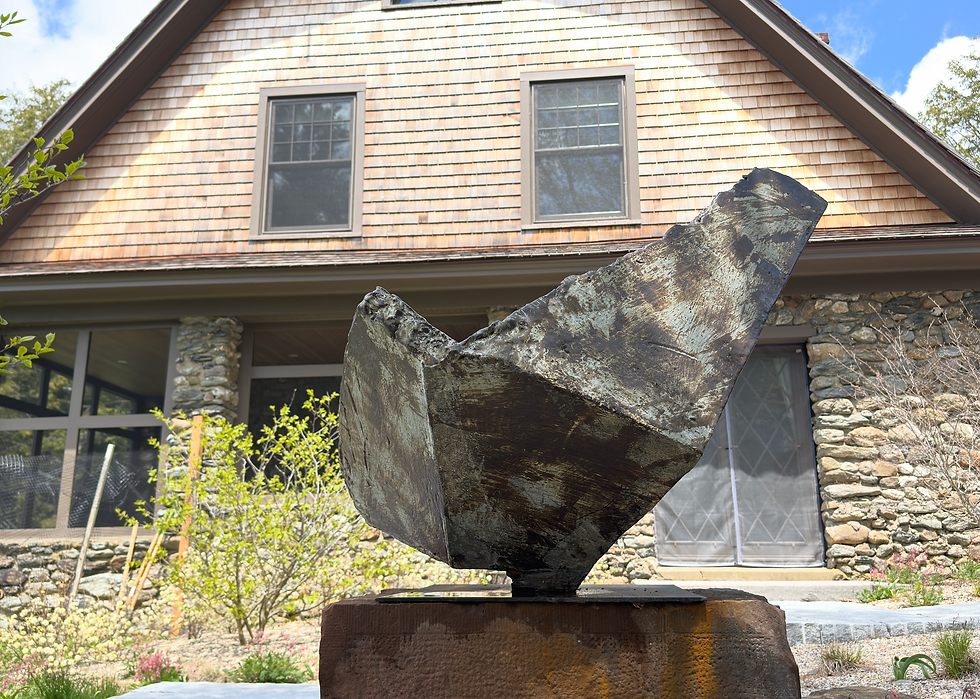
I followed Paul Chaleff through gardens and front lawns scattered across the Hudson River Valley. The intention was learning about the sculpture from his work, from pieces that have left the kiln, left the studio, and are now part of the landscape. We drove, and by the third stop I was no longer looking at sculpture. I was walking in the footsteps of a future archaeology, one that could perhaps one day walk in mine.
Imagine a traveler arriving here a thousand years from now. The houses are gone. The hedges are gone. The driveways are forest floor. Standing in the cleared meadows, still oriented to the cardinal points, are heavy clay monoliths, massive and deliberate, plainly made by human hands. What civilization placed them? What were they for?
This is the conceit I could not shake. It is also, I think, the question Chaleff's sculptures invite by their very placement.
We are practiced at reading the monumental art of the dead. We know what to do with the moai of Rapa Nui, the menhirs of Carnac, the Olmec heads of San Lorenzo, the kouroi of archaic Greece, the colossi of Memnon, the lamassu guardians of Nineveh. We file them under religion, ancestor cult, dynastic memory. Their makers worshipped something, and the stones are the evidence. The reading is theological even when the theology is lost.
There is a further distinction worth making here, and it is one our own training tends to obscure. The monuments of antiquity were figurative almost without exception. The moai are stylized human heads. The lamassu are winged bulls with human faces. The kouroi are young men, the lions of Delos are lions, the colossi of Memnon were once recognizable kings. Time and weather have softened these forms toward what looks to us like abstraction, and the modern eye, conditioned by Brancusi and Moore, is too quick to read the erosion as style. It is not. Beneath the wear lies a figure that the maker intended to be recognized. From Lascaux through Praxiteles through Bernini, what Wilhelm Worringer in 1908 called the empathic impulse — the desire to bind oneself to the world by reproducing its forms — held without serious interruption.
Where the antiquities were abstract — at Carnac, at Stonehenge, at Newgrange — they were also ritual. The geometry was instrumental: calendars, alignments, processional grammars. Abstraction served liturgy.
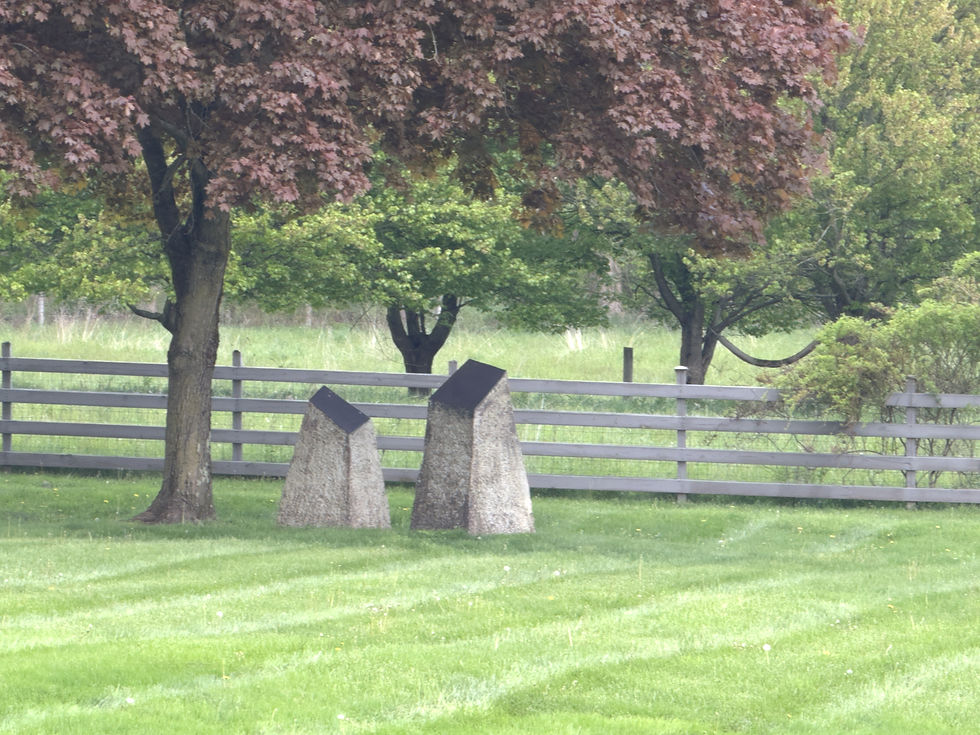
What I saw in upstate New York is something else entirely. Chaleff's pieces are not stylized figures. They are not figures at all. Nor are they part of a vocabulary used to convey a story. They begin in abstraction and remain there, and they answer to no rite. The collectors who placed them did not need a figure to identify with, a god to worship, a ruler to commemorate, or an equinox to mark. If there is a secret, they have the key — as with the two tall expressions of a loving relationship between the man and the woman who commissioned the work from Chaleff. Two tall figures standing side by side, separated by the unbearable tension of proximity. I would not know this had the artist himself not introduced me to the work. Does it matter? Yes, it does. I believe it does, if I am going to document his work. For the first time in the long history of monumental sculpture set out in the open air, what greets the wind is neither the representation of anything nor the instrument of any worship. It is itself.
The lawn sculptures in several homes of the Hudson Valley resist that initial impulse. They were not commissioned by a temple. No priest selected the site. No deity is implied. And yet the patrons — collectors of means — chose to take the art out of doors, away from the walls and the climate controls and the curatorial validation, and place it in open competition with the mountains. Why?
Robert Smithson saw this coming in 1966. In Entropy and the New Monuments, he argued that the monuments of his moment were no longer in the business of preserving the past. They proposed, instead, a future already emptied of meaning — what he called ruins in reverse, monuments built not for the ages but against them. Lucy Lippard, writing in Overlay in 1983, pursued the thought further: contemporary outdoor sculpture had quietly rejoined the territory of standing stones and ceremonial mounds, but without the ceremony. The form was ancient. The faith was gone. What remained was the impulse to mark — to insist that this ground, this view, this morning, mattered.
Alois Riegl, decades earlier, had already given us a useful distinction. In The Modern Cult of Monuments (1903), he separated the intentional monument — the kind a state erects to commemorate — from the unintentional one, the kind that becomes monumental only with the passage of time. The lawn sculptures of the valley are, for now, intentional. Given a millennium, they become unintentional, and the future archaeologist arrives with no Rosetta Stone.
Rosalind Krauss, in Sculpture in the Expanded Field (1979), described how the discipline had ceased to be a thing in the round and become instead a negotiation between landscape and architecture, site and non-site. Chaleff's work belongs to that negotiation. His pieces take their position in the landscape of the Hudson Valley, which already carries the institutional sculpture archive of Storm King a short drive south. The private lawns are domestic echoes of the public field. The collectors are, in their own way, building a small civilization in plain sight.
Shelley gave us the inverse case in 1818. The traveler in Ozymandias finds the broken colossus of a tyrant and reads the lesson of vanitas — look on my works, ye Mighty, and despair. The lawns of the valley reverse the line. There is no tyrant. The works do not boast. They sit. They weather. They wait. The traveler who arrives a thousand years from now will not find evidence of empire. He will find evidence of attention — that someone, at the end of the second millennium, looked at a Chaleff monolith and decided it belonged in the meadow.
This is the point at which the comparison with the older civilizations breaks down, and at which it becomes interesting. The remnants of Rome, Assyria, Egypt, the moai of Rapa Nui — all are evidence of belief in a god. The remnants of the Hudson Valley collectors will be evidence of belief in art. Not the worship of an artist, but a wager, made privately, that the object placed in the meadow has earned its place there.
A wager is not theology. It is closer to a quiet kind of nerve. The collectors who took these pieces out of the museum's protection and gave them to the weather seem to me to have understood that the museum had finished its work. The validation had been granted. Now the sculpture could go and live the rest of its life outside, under the sky, in the company of the mountains, the rattlesnakes, and the deer.
Walking these properties, I began to feel that the lawns were not landscape in the conventional sense at all. They were the interior of the house extended outward — the living room continued into the prado, the meadow into the foothills. The line between the domestic and the wild had been deliberately blurred, and the sculptures stood at the seam.
At one point the gesture became literal. On a lawn that sloped toward the valley floor, a vast metal frame had been installed — chromed or stainless, perhaps six meters on each side — placed so that, from inside the house, it framed a section of the mountain range exactly as a painting would. The view through the frame was indistinguishable in its formal logic from a Thomas Cole, a Frederic Church, an Asher Durand, a Bierstadt. The Hudson River School had spent the nineteenth century teaching Americans to see this valley as a picture and to hang the picture inside the parlor. The contemporary collector, with the means to do so, has reversed the operation: the picture has been removed, the frame has been carried outside, and the mountain itself has been hung in the parlor through the open window.
The lesson is the same lesson, restated with a kind of austere wit. We are the ones framing. The mountain was always there. The framing is the art. Once you accept that, every Chaleff piece placed at the edge of a lawn is itself an act of framing — of saying here, this view, this morning, this object in conversation with that ridgeline. The collector is not decorating. The collector is composing.
A word about that wager, and about what I mean and do not mean when I call these monuments secular. I do not mean stripped of meaning. The opposite. The monolith placed on the lawn is an argument. It speaks. The language it speaks is intentionally lax, elastic, infinitely plastic — it leaves room for the viewer to step inside the sentence and finish it differently each time. Representational art rarely permits this. The figure on the cross fixes its viewer in a single posture of reception. The monolith at the edge of the meadow does not. It offers itself, and waits. What waits is not nothing. It is meaning held in reserve, available to whoever spends the time on it.
I will admit that until these past two days I did not know where the force of these monumental ceramics actually came from. I knew the early work — the Anagama vessels, the wood-firing, the East Asian lineage. The later pieces — the ones now standing in the meadows — I had seen but not understood. Paul revealed the source to me in conversation. I will not name it here. The film we're working on is where that revelation belongs.
That is the role I think a documentary on an artist can play. Not to explain — explanation flattens — but to hand the viewer the grammar of the language the artist speaks. In Spanish we distinguish entender from comprender. The first is to grasp the surface of a thing. The second is to take it inside oneself. A film about Chaleff should not aim at understanding. It should aim at comprehension.
Whoever arrives in the year 3000 to puzzle over the cropped meadows will not find the museum. The museum will be gone. The validation will not have followed. What will be left is the work itself — fired clay, weather-pitted, oriented to the rising sun — and the slow inference that here, briefly, a civilization worshipped the made object for its own sake.
I do not know whether that constitutes a religion. I suspect Chaleff would say no. I suspect he would say it was simply a matter of placing the right thing in the right field, and trusting the field to do the rest.
Eduardo Montes-Bradley is a documentary filmmaker and the founder of Heritage Film Project. A documentary on the life and work of Paul Chaleff is currently in development.


Comments