


Understanding Cuba’s History Through Its Stained Glass
Updated: May 4
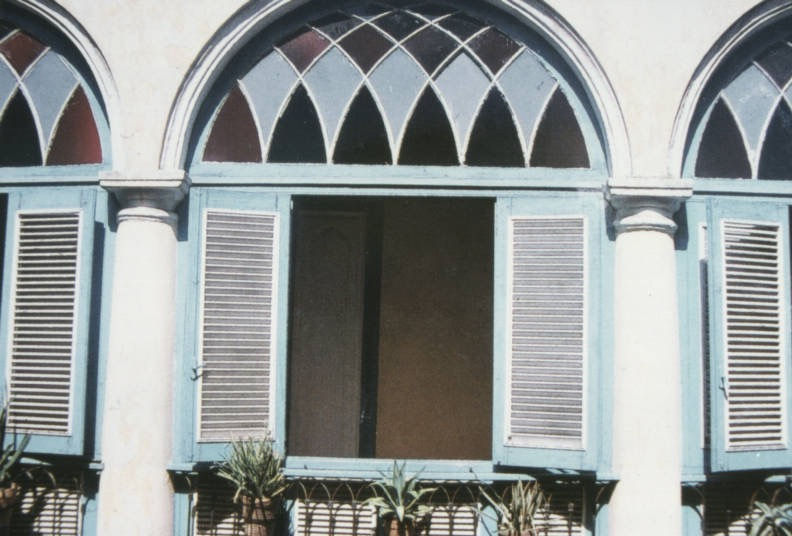
There is something unusual about the interior of many of the older homes in Havana, where daylight finds its way in through colored glass in stained-glass transom windows and lunettes. The effect is a distinctive feature of late nineteenth and early twentieth-century Cuban architecture, particularly in cities like Havana and Santiago, and surely throughout the island as well. This light, projected onto walls and furnishings throughout the day, has a unique way of painting interiors with delicate brushstrokes that often redefine skin tones and render alive the artwork, staircases, moldings, patios, and marble floors. This ambiance, one could say, is quintessentially habanero — though not unique to Havana.

This observation lies at the heart of Through the Looking Glass (El color del cristal con que se mira), a documentary film that proposes to explore Cuba's timeline — from discovery and colonial rule through the republican period, which ended with the irruption of the revolution of 1959.
Through the Looking Glass unfolds as a journey across the island, a road movie led and guided by Mirell Vázquez, whose work has revealed the extraordinary concentration of historic stained glass in Cuban architecture. Through our journey, each window, skylight, and interior panel becomes a point of entry into a broader historical moment.
Cuba's Stained Glass Legacy
During the colonial period, Havana houses commonly incorporated fan-shaped stained-glass transom windows and lunettes. These features, which some scholars trace to Mediterranean precedents in Spain and Italy — though distinctly adapted by Cuban Creole artisans who substituted wooden frames for the lead structures common in northern Europe — can still be appreciated above doors and windows and have long inspired artists such as Amelia Peláez and Humberto Calzada, who recognize in these ornaments a distinctive mark of Cuban cultural identity. It is this tradition that Mirell Vázquez has devoted years to documenting and preserving.

As Cuba stands at the threshold of a new chapter, a documentary film sets out to reveal the island nation's layered history through the luminous language of stained glass windows — treasures that have quietly witnessed it all.

Following the wars of independence, as wealth accumulated in the purses of sugar barons, new residential neighborhoods like Vedado flourished, and with them a distinct architecture. Mansions now incorporate stained-glass windows inspired by European styles. Most were imported from Spain and France, while a handful of examples were imported from Tiffany Studios in New York. Yet many were also produced locally by Cuban artisans.
Preservation and Storytelling
Among those studying and preserving this legacy today is Mirell Vázquez at the Escuela Taller in Havana. Through years of careful documentation, Mirell has identified roughly five hundred historic stained-glass works in Vedado alone — a remarkable concentration that speaks to the importance of this medium in the city's architectural culture.
The work of restoration is delicate and urgent. Havana's climate — humid, warm, and subject to sudden seasonal changes — can be unforgiving for glass and lead. Preserving these works requires both technical knowledge and patience. Mirell leads a small team of young restorers who carefully dismantle, clean, repair, and reassemble these windows piece by piece, returning them to their original luminosity.

The results can be extraordinary. In some restored houses, winter gardens glow with floral stained glass combining opaline glass and grisaille painting. In others, staircases are illuminated by works created by European glass ateliers such as the Champigneulle workshop in France. These windows are more than decoration; they shape the atmosphere of the interior space itself. As Mirell notes, once a stained-glass window is placed inside a building, it creates harmony through light.
For a filmmaker, this discovery suggests a powerful metaphor. Glass refracts light; history refracts memory. The film imagines Cuba as a kind of kaleidoscope — its fragments of culture, Spanish and African, French Caribbean and Chinese, American and Jewish, and Lebanese — continuously rearranging themselves into new patterns of light and meaning. Through the stained glass of Havana's houses and public buildings, one begins to glimpse these layered histories.
The global success of Buena Vista Social Club revealed the extraordinary power of Cuban music to captivate audiences around the world. Yet Cuba's cultural identity extends far beyond its musical traditions. CUBA: Through the Looking Glass seeks to expand that conversation by exploring the island's contributions to the visual and decorative arts, where architecture, craftsmanship, and color play an equally compelling role.
Two artists provide important visual references for this approach. Amelia Peláez, one of the most celebrated painters of modern Cuba, drew inspiration from colonial interiors, iron grilles, tiled floors, and stained-glass windows. Her paintings often resemble luminous architectural compositions where color behaves almost like stained glass itself. Likewise, the work of Humberto Calzada reflects on Havana's interiors with a quiet, contemplative precision — balconies, corridors, and filtered light becoming meditations on memory and place.
Together, these artistic traditions help frame the visual language of the film. The stained glass of Havana does more than decorate a building; it transforms space, shaping the atmosphere in which life unfolds.
From the luminous nave of Chartres Cathedral to the iridescent windows of Louis Comfort Tiffany, stained glass has always been more than decoration — it was the world's first technology designed to move the human spirit through light.
A Collaboration Across Distance
For me, this story carries a particular resonance — and an unusual origin. Mirell and I have never met. She lives in Havana; I live in Charlottesville, Virginia. For nearly a year now, our collaboration has unfolded entirely through WhatsApp calls, text messages, and emails — conversations that are frequently interrupted by power outages, by the recurring health crises that have swept through Cuba in recent months, by all the ordinary and extraordinary difficulties of life on the island today. In December, I booked a flight to Havana to meet her for the first time. A mosquito-borne epidemic forced me to cancel. We continue to plan.
What draws me to this project is not only the beauty of the glass but something more fragile: the survival of knowledge itself, passed from master to apprentice across generations, in a city where so much has been interrupted. And perhaps it is fitting that the film has begun this way — two people on either side of a complicated history, talking across distance and darkness, waiting for the light to be right.
In Havana, stained glass is not simply an architectural ornament. It is a conversation between sunlight, craftsmanship, and history. And through that glass, one might begin to see Cuba differently.
Support This Film
If this story resonates with you, I invite you to share it, leave a comment below, and subscribe to this blog for updates as CUBA: Through the Looking Glass continues to take shape.
This documentary is being developed with the support of the Documentary Film Fund, a 501(c)3 nonprofit organization dedicated to bringing stories like this one to the screen. Your contribution — at any level — helps make it possible to document, preserve, and share the cultural legacies that might otherwise be lost.
To support the film, please visit Documentary Film Fund link or click the donation button on this page.


Comments