


Habeas Corpus, Nidal Malik Hasan
The Crucifixion as Public Spectacle
A Two-Thousand-Year Tradition Should Hardly Surprise Us Today
In a recent article, The American Art of Looking Away, I considered the prospect of televising the execution of Nidal Malik Hasan, the former Army major convicted of killing thirteen people at Fort Hood. The responses were thoughtful, including those from readers who disagreed with me. Some suggested that my tone was detached, perhaps insufficiently disturbed by the possibility of an execution becoming a public spectacle.

I understand the objection. An execution is not entertainment, and making it visible does not make it just. But the discussion left me thinking about the distance between what we condemn as spectacle and what we have accepted, for centuries, as part of ordinary life.
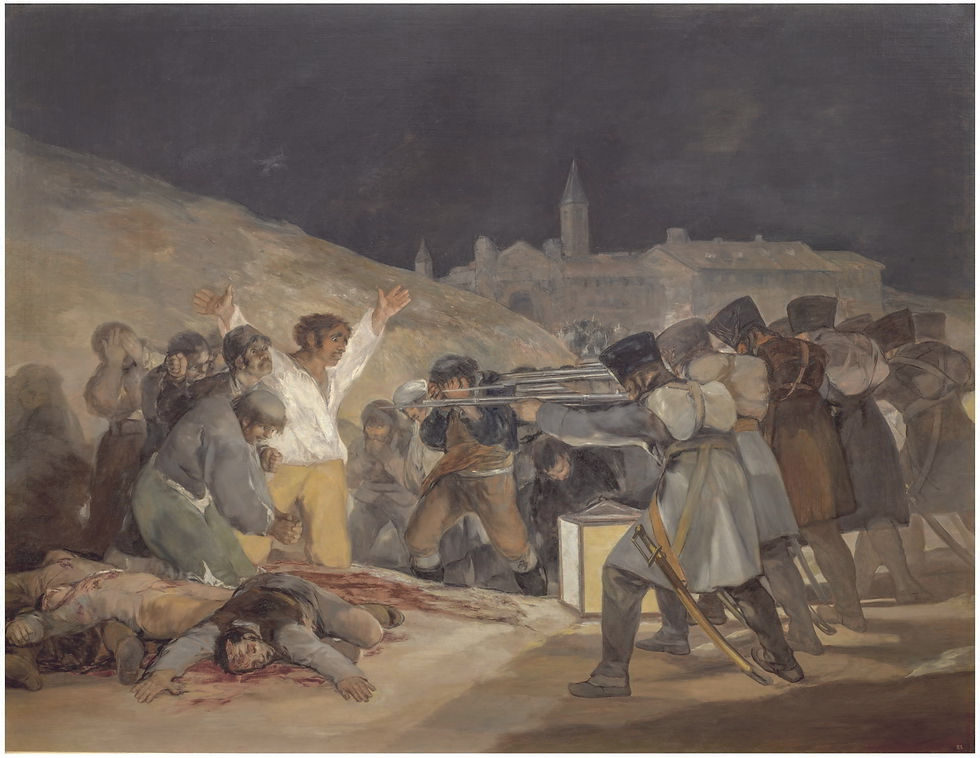
For nearly two thousand years, Christianity has placed the memory of a public execution at the center of Western religious imagination. Crucifixion was a Roman punishment designed not only to kill but to be seen. The condemned body was displayed as a warning, a demonstration of authority, a lesson addressed to anyone who happened to pass by. Yet that instrument of humiliation eventually became a symbol of redemption, mercy, and hope.

The transformation did not occur overnight. Constantine’s patronage helped Christianity move toward the center of imperial life in the fourth century, while representations of the suffering Christ and the familiar crucifix developed over subsequent centuries. What Rome intended as an image of terror gradually became one of the most recognizable images in Western civilization.
We encounter it not only in churches. It has hung in classrooms and hospital rooms, over beds, in family homes and public institutions. People wear the cross around their necks, press it to their lips, kiss it, and trace its shape across their bodies. The image accompanies births, illnesses, marriages, and funerals. We have not merely learned to look at the representation of an execution. We have learned to live with it, to carry it close to our bodies, even to embrace it.
That embrace is not an endorsement of Roman cruelty. For Christians, the cross signifies something profoundly different from what the Roman authorities intended. And that difference is precisely what interests me. The historical event remains the same, but the story surrounding it has transformed its meaning.
There is, of course, another distinction that must remain clear. Jesus’ confrontation with the money changers in the Temple is remembered as a challenge to an established religious order, although historians continue to debate its relationship to his arrest. Hasan’s attack at Fort Hood killed thirteen people and wounded thirty-two others. These acts are not morally equivalent, nor does examining their subsequent representations turn Hasan into a prophet or a martyr. The victims of his crimes must not disappear beneath the convenience of an analogy.
Still, an anthropological question remains. If Christianity understands Jesus’ death as a sacrifice for the sins of humanity, what would the state say Hasan’s death was for? Punishment for his crimes? Retribution? Deterrence? The restoration of moral order? And for whom would that restoration be performed? A society may insist that an execution serves justice while remaining deeply uncomfortable with allowing the public to witness it.
The distinction between witnessing and televising matters. A camera can turn suffering into a commodity, inviting voyeurism as easily as reflection. But concealment does not, by itself, settle the moral question. Neither visibility nor invisibility guarantees dignity.
Perhaps what unsettles us is not simply the sight of an execution but the meanings we attach to it. One representation becomes sacred, another intolerable. One enters the rituals of daily life, while another is considered too disturbing to be shown. These distinctions may be entirely defensible, but they deserve examination rather than reflexive condemnation.
And yet, the crucifixion raises another question, one that takes us beyond the spectacle itself. The Christian narrative does not end with the death of Jesus. It continues with the removal of his body from the cross, its burial, the discovery of the empty tomb, and the Resurrection. The body, even in its absence, becomes central to the story.
History offers other examples, considerably less sacred, in which the fate of a body has proved almost as consequential as the life that preceded it.
What to Do with a Corpse
Governments have long understood that a body is never just a body. Death may end a life, but it does not necessarily end the political significance of the person who inhabited it. Sometimes the corpse becomes more troublesome than the living individual ever was.
After Che Guevara was executed in La Higuera in 1967, his body was displayed on a concrete laundry sink in Vallegrande, Bolivia. The authorities wanted proof that the revolutionary was dead. Photographs circulated around the world, but the image acquired meanings its custodians could hardly have anticipated. The exposed body, surrounded by soldiers and onlookers, invited comparisons with representations of the dead Christ.
Thirty years later, in 1997, I documented the recovery of Guevara’s remains in Che: Rise and Fall for National Geographic. What stayed with me was not simply the discovery of bones buried beneath an airstrip, but the extraordinary significance those remains had acquired. The man had been dead for three decades, yet his bones could still command international attention, political ceremony, and public emotion. A secular kind of resurrection.
I encountered something similar while making my film Evita. Eva Perón’s embalmed body became so politically charged after the overthrow of her husband that it was removed from Argentina and secretly buried in Milan under a false name. The military authorities treated the remains of a dead woman as though they constituted an ongoing threat to the state.
The story did not end there. In 1970, the Montoneros kidnapped and executed General Pedro Eugenio Aramburu, a former president of Argentina who had played a central role in the overthrow of Perón. Among the accusations against him was his responsibility for the disappearance of Eva’s body. The demand for its return became entangled with the fate of another human being. A woman who had been dead for nearly eighteen years continued to influence the political life of her country.
Consider Lenin. The Soviet Union disappeared more than three decades ago, yet his embalmed body remains in a mausoleum in Moscow’s Red Square. The revolutionary state that preserved him has vanished, but its most conspicuous human relic survives. Putin has defended keeping the body there, even as contemporary Russia maintains a complicated relationship with its Soviet inheritance. Why preserve a corpse when the political order that sanctified it has collapsed? Perhaps because some myths require a physical anchor, even when their original meaning has changed.
In 2011, the United States adopted almost the opposite approach with Osama bin Laden. His body was buried at sea, leaving no grave that could become a place of pilgrimage. The decision reflected, among other considerations, a desire to prevent the creation of a shrine. Where the Bolivian authorities displayed Guevara, and the Soviets preserved Lenin, the Americans chose disappearance.
Four bodies, four approaches to the same problem. Display, concealment, preservation, disposal. Each reflects an attempt to influence what the living will remember, believe, or do. Yet none offers any guarantee that the desired meaning will prevail. Guevara’s image survived his execution and became an international emblem. Eva Perón’s missing body became a political obsession. Lenin remains on display long after the disappearance of the state that embalmed him. Bin Laden’s burial prevented a physical shrine but could not erase his symbolic significance.

The state may determine what happens to a body. It cannot determine what history will make of it.
This brings me back to Nidal Malik Hasan, whose execution is scheduled for December 3. Much of the present controversy concerns whether the public should be allowed to watch. But that is only the first question. The execution, if carried out, will produce another reality, one that cannot be disposed of quite so easily.

There will be a body. There will be decisions about its custody, its burial, its visibility, and perhaps the possibility of a grave becoming a place of remembrance or political identification. The authorities may regard these as administrative matters. History suggests otherwise.
I offer no answers, only questions. Questions about what we choose to see, what we prefer to conceal, and what happens when the spectacle is over. And one final interrogant: What are we going to do with the remains of Nidal Malik Hasan?


Comments