


The American Art of Looking Away
Public Execution, Goya, and the Ethics of Witnessing
The United States is preparing to execute Nidal Malik Hasan, the former Army major convicted of killing thirteen people and wounding thirty-two others at Fort Hood in 2009. The Army has scheduled his execution by firing squad for December 3, 2026. The Pentagon subsequently announced that the execution would be livestreamed, although President Donald Trump has said that he will make the final decision about the broadcast. Much of the immediate outrage has centered not on the execution itself, but on the possibility that the public might be allowed to watch it. The distinction is revealing.
One may reasonably oppose both the death penalty and its public display. One may also support the death penalty while believing that an execution should be conducted with solemnity and privacy. But the controversy raises an uncomfortable question: Which act do we consider barbaric—the state killing a human being, or the state allowing citizens to witness the killing carried out in their name?
Public executions were once both punishment and theater. In Shakespeare’s London, men, women, and children gathered to watch condemned prisoners hang, sometimes followed by mutilation and dismemberment. Severed heads were displayed as political warnings, while the bodies of criminals became objects of public curiosity. We have, thankfully, abandoned executions as popular recreation. But have we abandoned the violence, or merely improved the arrangements for keeping it out of sight?
Americans have always had a complicated relationship with public exposure. In 1911, when George Grey Barnard’s monumental sculptures—carved by the Piccirilli brothers—were installed at the Pennsylvania State Capitol, legislators were scandalized by the sight of male genitalia. The solution was wonderfully American: cover the offending marble anatomy with more marble. I explored this remarkable episode in my documentary The Piccirilli Factor. A civilization that admired the Italian Renaissance apparently found certain anatomical details of the Renaissance difficult to tolerate. One can almost imagine a legislator approving an execution before lunch and asking Michelangelo’s David to put on trousers before dinner.

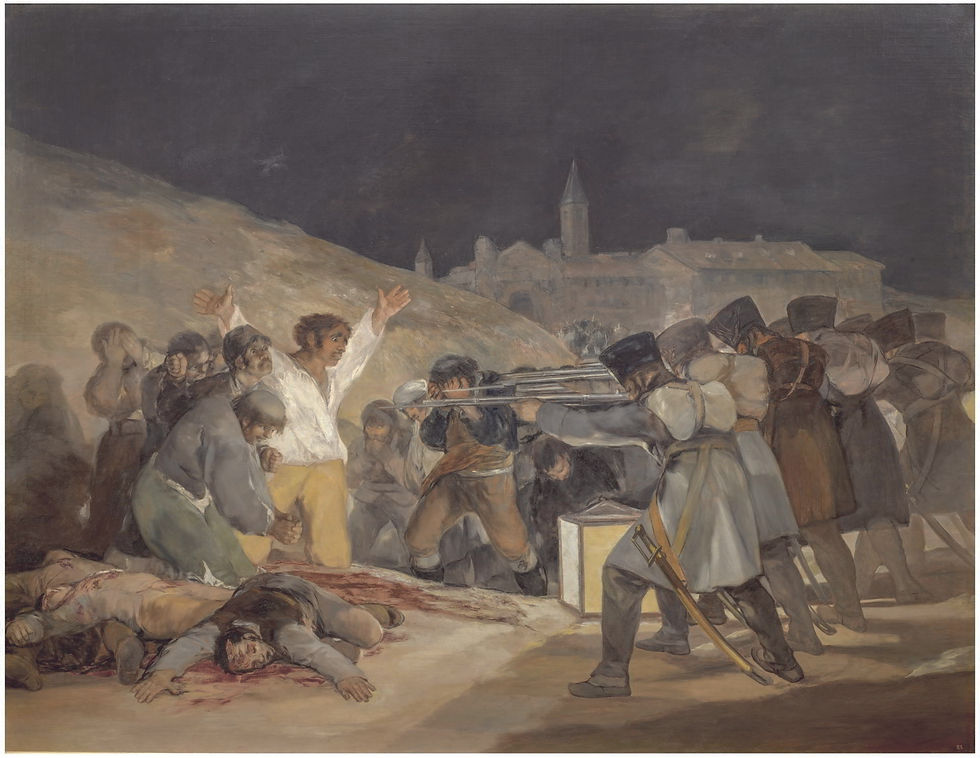
And then there is Francisco Goya. Consider The Third of May 1808, hanging in Madrid’s Museo del Prado. Visitors cross the Atlantic to stand before Goya’s depiction of Spanish civilians being executed by Napoleon’s soldiers. We admire his courage in confronting the brutality of war: the terrified faces, the raised arms, the rifles leveled at defenseless bodies, and the dead already lying in pools of blood. Nobody proposes covering the painting with a curtain to protect the public’s sensibilities.
Goya understood that making violence visible is not necessarily an endorsement of violence. It may be an act of accusation. The image can force the spectator to confront what political language, ceremony, and distance would otherwise conceal. A painting, of course, is not a livestream. Goya interpreted an atrocity after the event; he did not transmit a killing as it happened. His victims were civilians executed by an occupying army, not prisoners sentenced by a court. These distinctions matter, but they do not entirely resolve the question.
A government broadcast is not a neutral window. Someone selects the camera position, determines what will be shown and what will remain outside the frame, and decides how the event will be introduced. A livestream could become propaganda, political theater, or an invitation to morbid curiosity. It could diminish the condemned man’s final moments and deepen the suffering of the victims’ families. Once released, the images could be copied, edited, celebrated, mocked, and circulated indefinitely. These are serious objections and cannot be dismissed merely by invoking transparency.
In an ordinary production, a recognizable participant is asked to sign a release. There has been no indication that Hasan will be asked to consent to anything. Will he have any say in the worldwide transmission of his death, in whether his final words may be broadcast, or in whether the resulting images may be stored, copied and reused? The questions sound absurd because the language of production appears grotesquely misplaced in an execution chamber. Yet once the government introduces a camera and an audience, that language becomes unavoidable. Hasan is no longer only the object of a sentence; he has been assigned a role in a production over which he may exercise no editorial, contractual or moral control.
Yet secrecy also creates a form of political theater. It presents execution as an orderly administrative procedure rather than as the deliberate destruction of a human body. Witnesses are limited, language is regulated, and the machinery of death is placed behind institutional walls. The public is left with official statements, carefully chosen descriptions, and the reassuring abstraction of a sentence that has been “carried out.” An execution does not become more civilized because fewer people can see it.

The argument for visibility is not necessarily an argument for entertainment. A public record of government action is not the same as a public spectacle, although the distinction can be perilously thin. The question is whether citizens should be protected from the reality of a punishment imposed in their name (and paid by their taxes), or whether confronting that reality is part of the moral responsibility that comes with authorizing it.
There is also the question of profit. Who owns the image of an execution, and who acquires value from its circulation? The state provides the setting, the executioners, the camera and the means of distribution. Political figures may gain a spectacle of authority; broadcasters and digital platforms may gain viewers; commentators will gain material. Hasan contributes the one element without which the production cannot exist: his death. Yet he is not a consenting participant, much less a performer negotiating compensation for himself or his family. He becomes the captive subject of a state production whose image may continue circulating long after the sentence has been carried out. Even if no admission is charged and no advertising is sold, there are other forms of profit: political, ideological and theatrical. The question is whether citizens should be protected from the reality of a punishment imposed in their name, or whether confronting that reality is part of the moral responsibility that comes with authorizing it.
American audiences consume extraordinary quantities of fictional violence. Bodies are shot, strangled, burned, dismembered, and blown apart across our screens every evening. We call it entertainment, discuss the performances, admire the cinematography, give the productions awards, and move comfortably to the next episode. An actual execution is different, and that is precisely the point. It cannot be dismissed as choreography or undone when the director calls “cut.” There is no actor who rises after the scene. The difference between fictional and state violence is the difference between representation and irrevocable power.
Perhaps this is why the prospect of seeing an execution is so disturbing. The image would eliminate some of the distance that allows capital punishment to remain an abstraction. It would oblige the viewer to reconcile the language of justice with the physical fact of killing. That does not mean everyone should watch, nor does it mean that the state should transform an execution into a national broadcast. Refusing to watch may be an expression of conscience rather than indifference. But turning away from the image does not prevent the act from taking place.
We can have dinner, open a good bottle of wine, and watch a detective series in which half a dozen people are murdered before bedtime. Somewhere, inside a carefully supervised institution, the government may be preparing to kill someone according to law. There will be no troubling images, no interruption and no disturbance to our sensibilities. How reassuring.
The controversy surrounding the Hasan execution is therefore larger than the decision to position a camera inside an execution chamber. It concerns the relationship between violence, visibility, and public responsibility. What should a democratic society be required to witness? When does witnessing become voyeurism? When does discretion become concealment? Who benefits when the exercise of irreversible state power remains unseen?
Goya did not ask his audience to enjoy what they saw; he asked them to look. Two centuries later, we have still not decided whether looking is an act of conscience, an act of complicity, or sometimes both.
Join the conversation
Does making an execution visible encourage accountability, or does the camera inevitably transform punishment into spectacle? I welcome your thoughts below.
About the author: Eduardo Montes-Bradley is a documentary filmmaker and writer whose work explores art, history and cultural memory. His films include The Piccirilli Factor; inquiries concerning screenings, projects and collaborations may be directed through the site’s contact page.


Excellent essay – excellent analysis on a not-so-complex toxic cultural aspect of our culture.
I'm glad you point at the "entertainment" industry that perpetuates, trivializes and normalize violence as "entertainment".
A detail I would add is that not long ago we were horrified by the public executions carried by ISIS and the Telebaun, and now this fundamentalist Christian administration is coping such perverse behavior.
Fortunately we have a vaccine to prevent this self-inflicted, accepted and weaponized illness in our culture - VOTE!
P.S: the entertainment industry serves as an ideal tool to keep the masses "entertained", talking about, dreaming about fantasies, and not questioning, discussing, debating issues that matter.