


Che Guevara Believed North Korea Was a Model for Cuba to Follow
Updated: May 24
In a drawer at the Cuban Heritage Collection of the University of Miami, in a folder whose tab reads Personalities — Guevara, Ernesto and Kim Il Sung, there is a photograph.
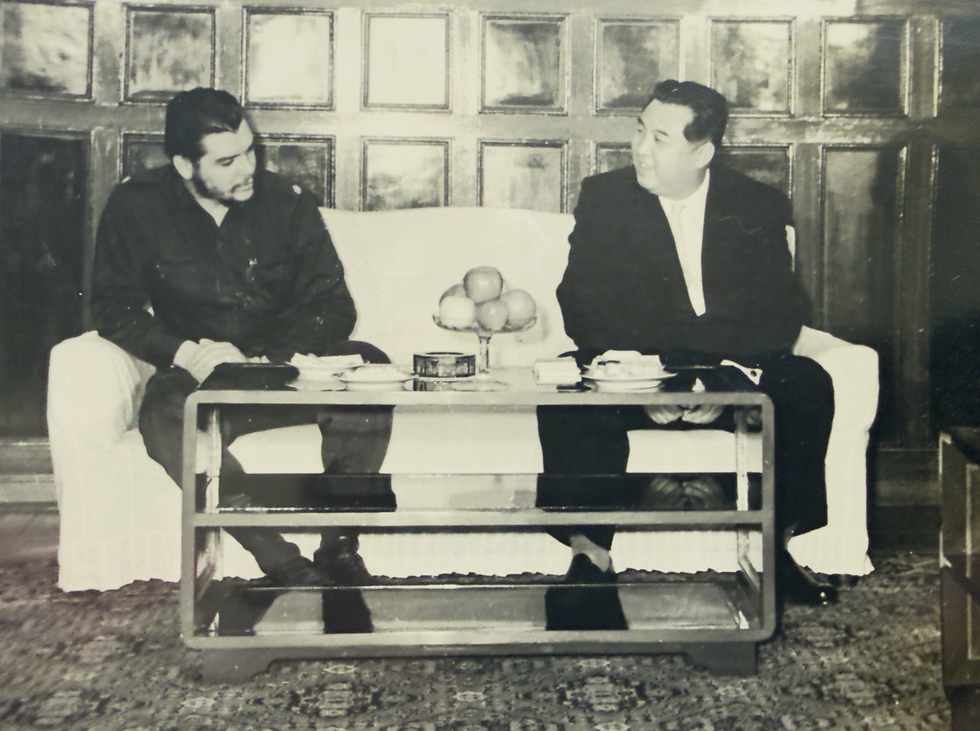
Two men are sitting on a couch. Between them, a low table holds a bowl of fruit and a small dish. The room is wood-panelled in the diplomatic style of the period — what could be the interior of any state guesthouse, anywhere in the world, in 1960. The man on the left wears olive fatigues and a beard. The man on the right wears a dark suit. They are leaning toward one another. They look like cousins.
The man on the left is thirty-two years old. He has been in Cuba for less than four years. He has not yet earned the face that will end up on T-shirts. The man on the right is forty-eight. He has been the head of a state for twelve years, and he will remain so for the next thirty-four. The bones of the regime he will leave behind — the political prison camps, the doctrine that the families of dissenters must be punished through three generations, the most durable totalitarian apparatus of the twentieth century — are already in place. Kaechon, Camp 14, still operating today, opened the year before this photograph was taken.
After the meeting, in his report on the trip, Ernesto Guevara proclaimed that the Democratic People's Republic of Korea was a model for Cuba to follow.
He meant it. Kim later sent arms to Cuba, reportedly free of charge. Fidel publicly called him an irreproachable combatant and a friend of Cuba. Diplomatic relations between the two states, established three months before this photograph was taken, have lasted sixty-six years and counting. I want to sit with this image, because of what it tells us about the man on the left.
In December 1964, four years after he sat with Kim Il Sung, Ernesto Guevara stood at the rostrum of the United Nations General Assembly in New York and delivered the speech that more than any other public act secured his reputation as the moral voice of anti-colonial revolution. He denounced American intervention in Vietnam. He denounced the murder of Patrice Lumumba in the Congo. He denounced the continued colonial status of Puerto Rico. He spoke for the dignity of peoples held captive by imperial powers, and he framed the Cuban Revolution as the conscience of that struggle.
It is a remarkable speech. It is also the speech that, more than any photograph or any beret, manufactured the figure who would become a global icon of resistance to domination.
The man who delivered it had, four years earlier, declared a regime that was actively imprisoning its own citizens in newly-built political camps to be a model for his own country to follow.
The two positions are not in tension only if one believes that denouncing imperialism elsewhere licenses participating in the construction of a totalitarian state at home.
I am not the first to notice this. Cuban exile writers have been noticing it for sixty years. What I want to draw attention to is something quieter, and in some ways more important than the contradiction itself.
The photograph exists. It exists in a drawer in Miami. It exists because someone, decades ago, decided that the pairing of these two names deserved its own folder, its own subject heading, its own act of preservation. The Cuban Heritage Collection holds it not because the diaspora endorses what it depicts, but because the diaspora's commitment to memory is broader than its politics. The collection preserves the iconography of the Revolution alongside the iconography of the Republic the Revolution displaced. It refuses to let either one disappear.
This is the work the Cuban Heritage Collection has done, quietly and without fanfare, for more than half a century. It is the largest archive of Cuban exile materials in the world. Inside its drawers are the photographs, the letters, the films, the diaries, the personal papers of a country that no longer fully exists in the place where it began. The folder I opened to find this image sits beside hundreds of thousands of other folders, each of them an act of refusal — a refusal to let the historical record be written by the regime that displaced its makers.
I went to Miami in May to explore ideas for a possible documentary about the Cuban Republic — the country that lived between independence and revolution, between 1902 and 1959, and the arts it produced in those fifty-seven years. Whether the film exists yet, I am not ready to say. What I can say is that the research has begun, and that this photograph is one of the things I found.
This photograph does not belong to the Republic. It belongs to what came after — to the years in which the Revolution was choosing its alliances and its models. But it tells me something useful about why the institution that holds it is worth defending.
The Revolution chose its models, and one of those models was Kim Il Sung's North Korea. The choice was made by men who would later present themselves as the moral conscience of the colonized world. The photograph is the document of that choice. The folder is the proof that the choice was remembered.
The man on the couch in 1960 was not yet the icon. The icon was manufactured in 1964 at the rostrum of the UN, and refined for decades afterward in the studios of Alberto Korda's photograph and the printers of a thousand poster shops in Paris and Berkeley and Mexico City. The icon is what survives in the cultural memory of the global left. The man who sat with Kim Il Sung is what survives in a folder in Miami. Both are real. Only one is famous.


Comments