


Modern Cuban Painters, Revisited
A Tuesday afternoon at the Frost
I had an hour to myself on Tuesday between meetings, and I spent it inside Modern Cuban Painters from Havana to New York: Revisited, the exhibition currently on view at the Frost Art Museum at FIU, co-curated with Casa Cuba and the Fundación Mariano Rodríguez. The title is doing a lot of work. Revisited is the operative word: this is a return to the landmark 1944 exhibition Modern Cuban Painters at the Museum of Modern Art in New York, the first U.S. institutional presentation of modern Cuban art, curated by MoMA's founding director Alfred H. Barr Jr.
The Frost's premise is to recover that 1944 moment and to put the paintings back in front of an American audience eighty-two years later. It works. The walls hold Peláez, Carreño, Portocarrero, Mariano Rodríguez, Cundo Bermúdez, Fidelio Ponce.
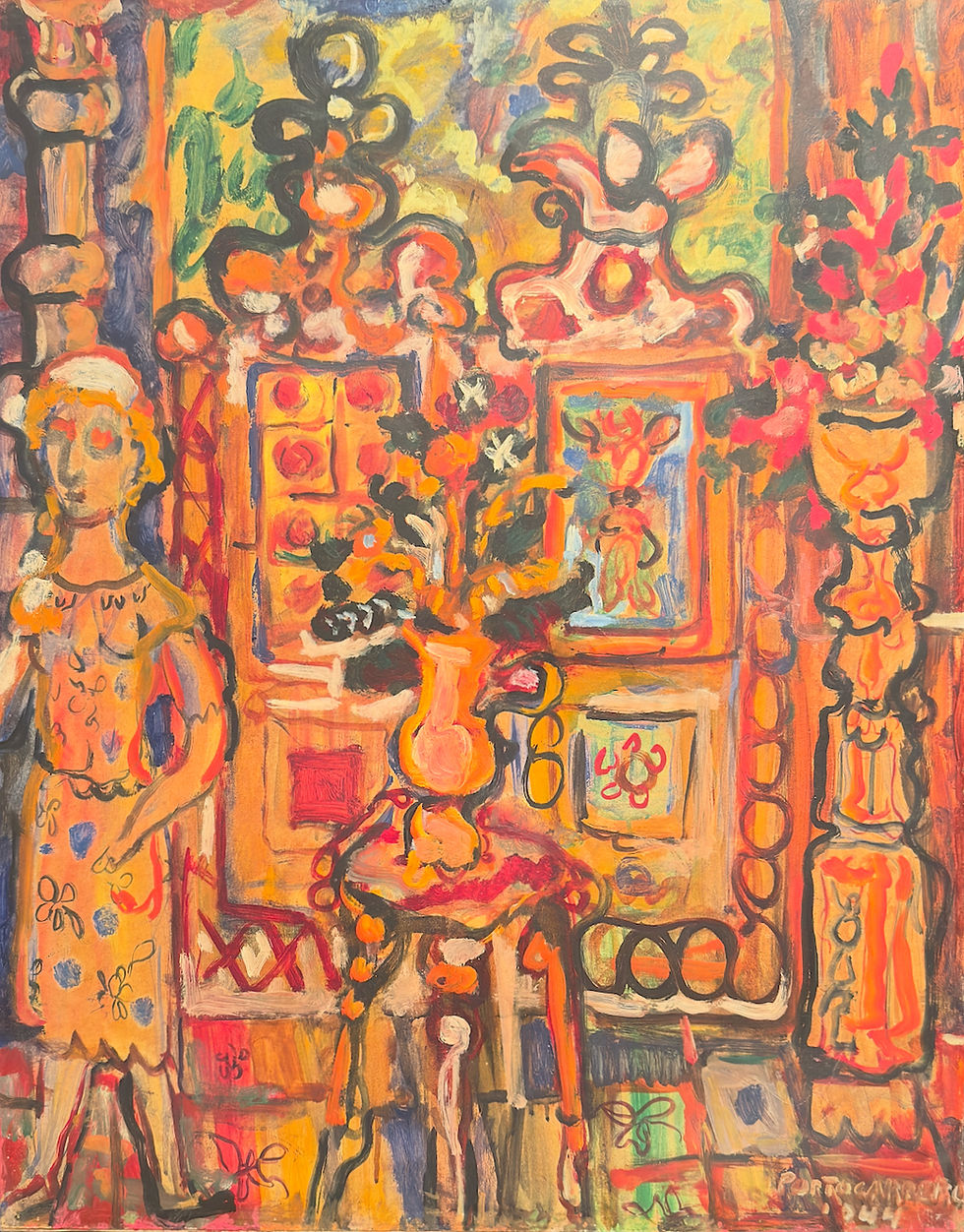
In 1942, Barr and curator Edgar Kaufmann Jr. traveled to Havana with the explicit purpose of acquiring Cuban art. They were hosted by the art patron María Luisa Gómez Mena, by her husband the painter Mario Carreño, and by the critic José Gómez Sicre — the same Gómez Sicre who would later, at the Organization of American States, become one of the central figures of inter-American art curation in the second half of the twentieth century. From those Havana studio visits the 1944 MoMA exhibition was built. Modernism, the wall text says, was being asked to expand beyond Europe, the United States, and Mexico. Cuba was the test case.


Two absences from the 1944 show are worth holding onto, because they shape the longer story. Wifredo Lam declined Barr's invitation. He had returned to Havana in July 1941 after eighteen years in Spain and France, and his ties to Picasso and Pierre Loeb placed his work on an international stage that he chose not to fold back into the national frame Barr was assembling. The Frost gives Lam his own room, alongside Fidelio Ponce de León — the painter who never left the island, who worked in whites and grays and ochres against his compatriots' embrace of color, and whom Barr admired so deeply on his 1942 visit that Ponce became central to the international recognition of Cuban modernism without ever boarding a ship.

The pairing of Lam and Ponce as the two independents — one who refused the frame from inside the international circuit, one who refused the frame by staying home — is the curatorial argument I will be thinking about for a while. It maps onto something larger about Cuban art and Cuban life across the twentieth century: the perpetual negotiation between leaving and staying, between the international and the rooted, between the gallery in New York and the studio in Havana.
What surprised me most, walking the rooms, was how legibly the 1944 selection still reads as a coherent generation. The post-1938 turn to the baroque, to Afro-Cuban iconography, to the countryside and the still life and the quiet interior — gone the picturesque white-Cuban domestic scenes, gone the decorative — is visible in the works themselves without need of explanation. The wall text formalizes what the paintings already say.

I went to Miami for other reasons this week, and the meetings of the past two days have left me with a great deal to think about. The Frost exhibition was not on the schedule. I found it by walking. But the conversation I have been having with Carolina Calzada and with the team at Casa Cuba about the documentary we are now building together — Cuba: Through the Looking Glass — turns precisely on this question of what Cuban art has meant outside the island, and what it means now to look back at the moments when the United States first reached toward Havana to acknowledge what was happening there. The Frost's Revisited is, in a sense, the work the film hopes to continue: not to recover what is lost, but to read again, more slowly, what was already there.
The exhibition is on view through the summer.
Modern Cuban Painters from Havana to New York: Revisited is co-curated by the Frost Art Museum at FIU with the Fundación Mariano Rodríguez and supported by Miami-Dade County, the Green Foundation, and Casa Cuba at the Benjamín León Jr. Building at FIU.

Comments