


Note from Cuban poet José Kozer on a Documentary Film about Alice Parker
Updated: May 18
The distinguished Cuban poet, a shelf at the Cuban Heritage Collection, and a letter remembered
This week, while Gladys Gómez-Rossie was walking me through the archives at the Cuban Heritage Collection at the University of Miami, my eye caught a name on the shelves: José Kozer. One of the major Cuban poets of the twentieth century, born in Havana in 1940, in exile in the United States since 1960, author of more than seven thousand poems and a central figure of the Neo-Baroque tradition in Spanish-American letters. His papers being at CHC is one of those decisions that the future will thank the present for.
Seeing his name on the box reminded me, suddenly and physically, of a letter Kozer had sent me some time ago after watching my documentary on the composer and choral director Alice Parker (1925–2023). I had not thought of the letter in a while. When I returned to my room that evening I looked it up in my correspondence. There it was.
The note is short and dense, written in the long, braided sentences that are characteristic of Kozer's prose. On rereading it now, I find it is not so much a comment on the film as it is a brief essay on what documentary can be when it is made as a collaboration — the way a potter or a poet collaborates. It is also, in passing, one of the most generous readings of my own working method I have received from anyone. I owe him a debt I had not fully recognized at the time.
I am reproducing the commentary here in English, with a translation that tries to honor Kozer's voice without flattening it. The original Spanish appears below.

A letter from Jose Kozer. English translation
Dear Eduardo,
The documentary, in the complex world of cinema as art, music, and poetry, is the artistic mode that most interests me at this historical moment. It is its present and its long-term future. It is a living, life-giving outpouring of matter and spirituality, struggling — in human contention — to find its center, an expansive and mobile center that shifts its place throughout a wide space all the time.
All the time is the thirty minutes of this documentary.
For me, it has the further appeal that it must be built — or, more than anything, made — as the potter makes, as the poet makes, in a team. Alice Parker collaborating with Eduardo Montes-Bradley is a team, just as Bradley collaborating with a camera is a team, with questions that are stimulating because they are modest, and because they let the subject of the camera breathe, which is to say unfold — the unfolding of impressions, of fragments coupled as a later scaffold, which in their totality constitute the documentary. It is harmony, which is a form centered on humility, that is to say, on collaboration.
In collaborating we are One Among Equals, Primus Inter Pares, as Parker is as teacher, as choral director, as object and as subject of a documentary that is in turn a snowed-in landscape, a place — in this case the place of Thoreau, Emerson, Hawthorne, Melville, the place of transcendentalism, which in my view is to date the best, or perhaps simply the best, that the United States has produced.
Unity, centrality in perpetual movement, is the composer Alice Parker among her students, her compositions, her sense of the present and of the small, perhaps of the ephemerality of human and inanimate things, perhaps without anything beyond. The class, the choral teaching, the melodic, and the eventual abolition of time and space — so that we wake up singing, rethinking Emily Dickinson, rethinking the marvelous Eudora Welty, one of the most authentic and most fully developed literary ears in the country.
I applaud the unceasing labor — revelatory of living voices and a living record, present and of long future relevance — that Montes-Bradley carries out, persistent, quietly and without fuss, leaving behind a trail of his own and of everyone's, of everything his third and singular eye catches in order to lift up. — José Kozer

A letter from Jose Kozer. Original Spanish
Querido Eduardo
El documental, en el complejo mundo del cine como arte, música y poesía, es el modo artístico que en este momento histórico más me interesa. Es su presente y su futuro a largo plazo. Es un vertedero vivo, vivificante de materia y espiritualidad, que pugna, humana contienda, por dar con su centro, centro expansivo y centro móvil que muda de sitio, en un amplio espacio todo el tiempo. Todo el tiempo son los treinta minutos de este documental.
Para mí, además, tiene el aliciente de que ha de construirse o más que nada hacerse, como hace el alfarero y hace el poeta, en equipo. Es equipo Alice Parker colaborando con Eduardo Montes Bradley como lo es Bradley colaborando con una cámara, unas preguntas estimulantes por modestas, y porque deja respirar, que es desplegarse, al sujeto de la cámara, del despliegue de impresiones, fragmentos copulados como sostén ulterior que integran en su totalidad el documental. Es armonía, que es una forma centrada en la humildad, es decir, la colaboración.
Al colaborar somos Uno Entre Pares, Primus Inter Pares, como lo es Parker en cuanto profesora, directora coral, objeto y sujeto de un documental, que es a su vez naturaleza nevada, sitio, en este caso el sitio de Thoreau, Emerson, Hawthorne, Melville, sitio del trascendentalismo, opino que hasta la fecha de lo mejor o tal vez lo mejor que ha dado Estados Unidos.
Unidad, centralidad en perpetuo movimiento es la compositora Alice Parker entre sus alumnos, sus composiciones, su sentido del presente y de lo pequeño, quizás de lo efímero de las cosas humanas e inanimadas, quizás sin ulterioridad. La clase, la enseñanza coral, la melódica, y la abolición en última instancia del tiempo y el espacio, de manera que despertamos cantando, repensando a Emily Dickinson, a la maravillosa Eudora Welty, uno de los oídos literarios más auténticos y mejor desarrollado del país.
Aplaudo la labor incesante, reveladora de voces vivas y registro vivo, actual y de futura y larga actualidad que realiza Montes Bradley, persistente, a la chita callando y dejando un rastro propio y de todos, de todo lo que su ojo tercero y único capta para enaltecerlo. — José Kozer
I include both versions for the reader who can read Kozer in his own language, and because his Spanish carries a rhythm that no English translation will ever fully recover. The Neo-Baroque is, in part, a music. The translation gives the thought; the Spanish gives the music. Both are owed.
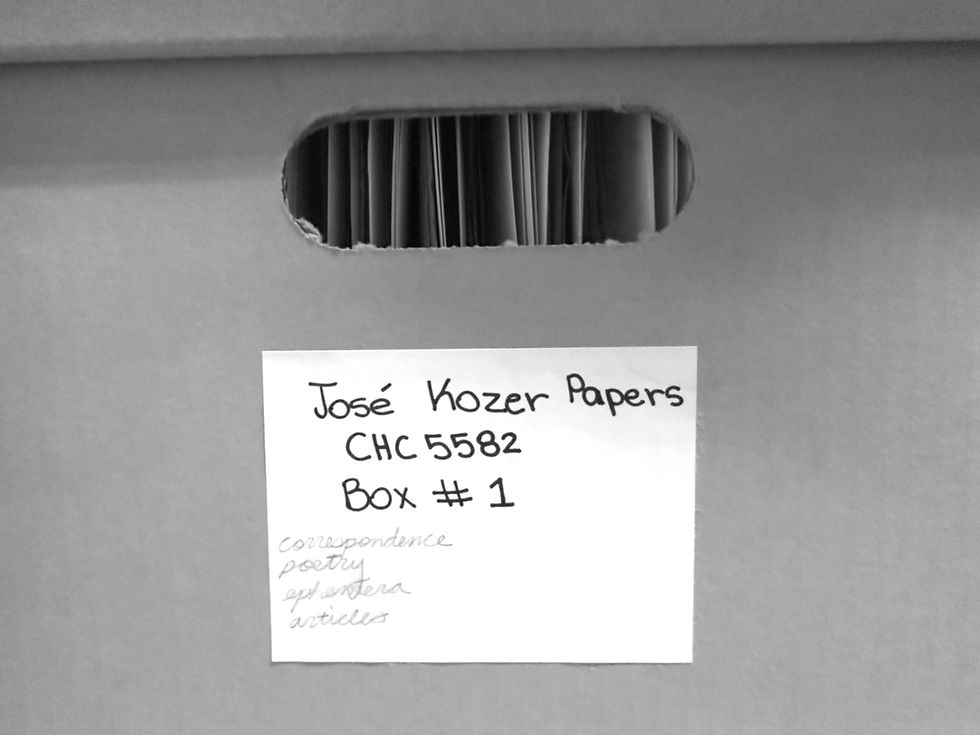
To see his name on a shelf in the CHC, in a week in which I was thinking about Cuban memory and Cuban exile and what it means for a community to preserve its own paper across sixty-five years of separation, and to have that sighting return me, hours later, to a letter sitting in my own correspondence — that is the kind of accidental architecture an archive performs without anyone noticing. José Kozer is alive and writing within an hour of where I sat reading the spine of his folder. I will write to him to say I owe him a longer thank-you than I have ever given him.


Comments