


Exploring Joaquín Sorolla's Vision of Spain
Updated: Feb 6
I’ve long been drawn to Joaquín Sorolla’s command of light and his deep connection to Spanish identity, especially his final grand commission—the Vision of Spain murals for the Hispanic Society of America. Those fourteen monumental panels depict Spain’s regional cultures in all their sun-soaked particularity. They have sparked ideas for a future documentary. So, I crossed the Atlantic, only to find the Museo Sorolla in Madrid closed for renovations. Its historic artist’s residence was dismantled, studios packed away, and masterpieces removed.
The solution was Spain’s high-speed train to Valencia, Sorolla’s birthplace. The Fundación Bancaja has mounted a comprehensive exhibition drawing from the museum’s vast holdings. The show traces his evolution thematically and chronologically—a welcome substitute until Madrid reopens in early 2026. What follows are observations from the galleries, notebook in hand, thinking about how these works might translate to screen.
The Sea: Iconography of Light
Sorolla transformed the Mediterranean from subject into symbol—light’s endless play made visible. His beaches pulse with atmospheric intensity. Fishermen haul nets, children splash in the shallows, and waves are caught mid-surge with chromatic precision. The exhibition includes his bourgeois beach scenes from Biarritz, Zarauz, and San Sebastián. However, the Balearic works—particularly those from Cala de San Vicente in Pollença, Mallorca—go deeper. Their vibrant blues carry echoes of ancient Greek ideals, bathing everyday shores in something approaching the timeless. These paintings operate as both immediate sensory experiences and meditations on creativity itself.
Cinematographer Ricardo Aronovich understood this early. He has long insisted, in conversations over the years, that Sorolla’s treatment of light should be taught in photography schools as a benchmark for understanding the relationship between color and illumination. This is not just theory, but an observed natural phenomenon. Standing before these Mediterranean canvases, you see what Aronovich meant. Sorolla wasn’t painting beaches; he was documenting how light behaves when it meets water, flesh, fabric, and atmosphere.
Spain Portrayed
This section presents Sorolla as an itinerant chronicler, painting Spain en plein air from Valencia’s orchards to Castilian monuments. The works become a visual argument about Spanish identity, shaped by the cultural crisis of 1898. This was when Spain lost its final colonial possessions in Cuba, Puerto Rico, and the Philippines. The country was forced to reckon with what remained, culminating in the 1911 Hispanic Society commission.
His brushwork celebrates light, history, and culture as regenerative forces. The range is striking: rural labor rendered with documentary rigor, urban grandeur captured in luminous shorthand, and preparatory studies that foreshadow the monumental regional panels. It reads like a visual manifesto—mapping places where tradition meets transformation, which is precisely what interests me for the documentary.
The Journey: Exhibition Overview
The exhibition maps Sorolla’s path from Italian academic training and early Valencian work through Madrid success to international recognition. After settling in the capital in 1889 and marrying Clotilde García del Castillo, he built a career that encompassed academic nudes, dramatic fishing scenes shaped by social realism, and the luminous plein-air works that made his reputation at Paris expositions. This culminated in his landmark 1909 one-man exhibition at the Hispanic Society of America in New York.
His constant travel—from youthful study trips to mature sessions capturing Mediterranean light in gardens and coastal sequences—creates a narrative arc you could follow. The provincial prodigy becomes a cultural icon. An early peak arrives with the 1892 gold medal at the International Fine Arts Exposition for his nude Estudio de desnudo. Seeing this progression in Valencia, where it all began, the AVE detour from Madrid feels less like an accident than logic.
Archival Integration: Process Made Visible
Among the exhibition’s smartest choices are enlarged photographs of Sorolla at work, hung beside the finished canvases they document. The pairing makes both photograph and painting more immediate. The archival image gains authority from the completed work, while the painting becomes more tangible through evidence of its making.
One photograph from his late Mallorcan period especially stayed with me. It shows Sorolla painting outdoors with Clotilde and their daughter Elena seated beside the easel. This family outing doubles as a working session. The image collapses the boundary between life and work, revealing how domestic stability supported public achievement. For filming purposes, documentation like this is gold. It captures the angle of light, his physical relationship to the canvas, and the social context of creation.
The Gardener Painter
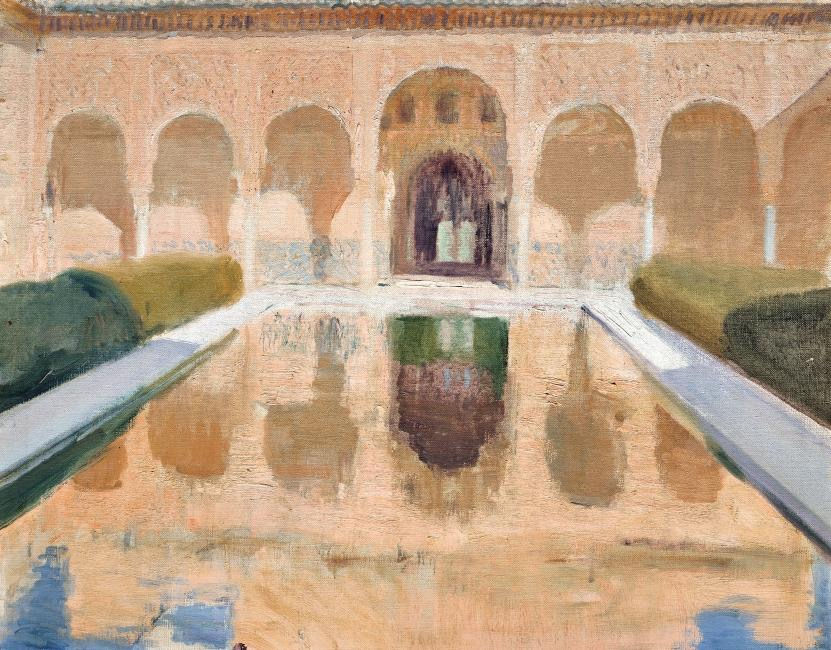
Gardens functioned for Sorolla as hybrid territory. Nature’s abundance was shaped by architectural order. Fountains, foliage, and flowers under shifting light become metaphors for refuge and sensuality. From Seville’s Alcázar to his Madrid home, he painted these spaces as cultural Edens. He drew on Hispano-Moorish tradition and, at times, as in La Granja de San Ildefonso (1907), Austrian Baroque grandeur. The canvases hold chromatic intensity and compositional balance at once. In a documentary, these could serve as quieter moments—Sorolla between monumental commissions, synthesizing influences in spaces both cultivated and wild.
The Cavall Bernat Series
This 1919 Mallorcan suite, painted during family time, fixates on the rocky promontory of Cavall Bernat. Variations in light, texture, and color push toward abstraction. Emerald waters, sunset atmospherics, and waves against stone are all caught with rapid brushwork under difficult outdoor conditions.
The series reads as a farewell to his Mediterranean obsession, painted as illness began limiting his mobility. Standing with these paintings, their urgency is palpable. It feels like a career’s goodbye to the landscape that defined his vision. For film, it could function as a climax—Sorolla at the water’s edge, legacy secure, confronting the sublime one last time.
Family Portraits
Here the intimate Sorolla emerges. He painted portraits of cultural figures, intellectuals, and his family—Clotilde and the children—in compositions that balance formality with genuine warmth. The settings shift from studio interiors to spontaneous outdoor scenes. The works show careful construction, elegant handling of material, and real psychological depth. They capture life’s passing moments with technical precision.
Certain details linger in the mind. Clotilde’s direct gaze asserts her presence within traditional portraiture. Elena is caught in Santander sunlight. These images humanize the public figure, anchoring grand commissions in family devotion. For storytelling purposes, they are essential—family as stability amid international fame and constant travel.
Valencia’s Proprietary Pride
Valencia claims Sorolla completely. His name marks the train station, street signs, cafés, and cultural centers. This matters more than civic boosterism suggests. Valencia shaped his palette, his attraction to maritime subjects, and his understanding of Mediterranean light as both physical fact and cultural inheritance. The city’s pride in its native son is everywhere, turning a research visit into a conversation with living memory. Any documentary has to acknowledge this foundation—not as background, but as a constitutive element of his vision.
Final Reflections
This Valencia exhibition is more than a stopgap. It offers Sorolla in his home context and strengthens my thinking about a documentary exploring the Vision of Spain murals. The show closes soon (check Fundación Bancaja for dates). For anyone pursuing similar work, Valencia repays attention. The city’s light still feels like the raw material of Sorolla’s vision.
In conclusion, the journey through Sorolla's work offers insights not just into his artistic process but also into the cultural identity of Spain. The interplay of light, family, and landscape creates a narrative that is both personal and universal. As I continue to develop ideas for the documentary, I am reminded that the essence of Sorolla's art lies in its ability to capture the fleeting moments of life, much like the light he so masterfully portrayed.
If this resonated, feel free to share it—or write me.


Comments