Search Results
460 results found with an empty search
- Over The Lincoln Memorial
It was a very special day. As we were flying back from Florida to work on a last revision of “Daniel Chester French: American Sculptor” before the premiere this coming weekend @mahaiwetent performing arts center in #greatbarrington , the monument revealed itself before us. On final approach the jet banked right, then left, and when we spoted the Potomac, I knew the gift was just about to unwrap before me, and there it was the jewel crowning the American Renaissance Experience.
- Read All About It
”Chesterwood is where he’s alive. If you want to find answers to French, you have to go to Chesterwood. It’s a little bit like a temple, like a shrine,” says Montes-Bradley during one of his many trips to Stockbridge to research and film. Montes-Bradley hopes that viewers of his documentary will recognize the importance of location and space as catalysts for inspiration and change. Read More
- BITS & BYTES
Chesterwood will mark the centennial anniversary of the Lincoln Memorial with the premiere of a documentary about its creator, sculptor Daniel Chester French, followed by a panel discussion and reception, at the Mahaiwe, Thursday, May 26. Photo courtesy the Mahaiwe. STOCKBRIDGE, The Berkshire Edge — Chesterwood, a site of the National Trust for Historic Preservation, will mark the centennial anniversary of the Lincoln Memorial with the premiere of a documentary film that explores the life and work of Daniel Chester French (1850–1931), sculptor of the iconic Abraham Lincoln seated beneath architect Henry Bacon’s Parthenon-inspired temple in Washington, D.C. Written and directed by award-winning filmmaker Eduardo Montes-Bradley of the Heritage Film Project, “Daniel Chester French: American Sculptor” will serve as an educational tool, build a worldwide audience for French’s work, and introduce the public to Chesterwood, French’s summer home, studio, and gardens. The film is set to premiere May 26 at 7 p.m.at the Mahaiwe Performing Arts Center in Great Barrington as part of several nationwide centennial commemorative events. Opening remarks will be presented by Michael Bobbitt, executive director of the Mass Cultural Council and honorary chair of the event. The screening will be followed by a scholarly panel discussion and a benefit dessert reception. Tickets to both the screening and reception are on sale at the Mahaiwe website. The film will include interviews with several French scholars, including Michael Richman, the curator of the first major exhibition and catalogue of French’s work, and Lincoln scholar Harold Holzer, author of the recently published biography “Monument Man: The Life and Art of Daniel Chester French.” This is the first-ever documentary to focus on French, including his formative years studying with May Alcott, his neighbor in Concord, Massachusetts; apprenticing with American sculptor Thomas Ball in Florence, Italy; establishing a studio in Greenwich Village; and finding his true creative home at Chesterwood. The film will look at the aesthetic and political significance of French’s hundreds of public sculptures, such as the Minute Man in Concord, the John Harvard at Harvard University, the Alma Mater at Columbia University, the Richard Morris Hunt Memorial on Fifth Avenue in New York City, the General George Washington on the Place d’Iléna in Paris, and the universally known seated Abraham Lincoln at the Lincoln Memorial. Immediately following the film screening, Montes-Bradley will be joined by Holzer and American art scholar Dr. Thayer Tolles to discuss the film. Dr. Tolles is the Marcia F. Vilcek Curator of American Paintings and Sculpture at the Metropolitan Museum of Art, where she served as editor and co-author of a two-volume catalogue of the Museum’s historic American sculpture collection.
- On the Road
Concord, Mass - On location and with hardly any time to update my notes on the production of “Daniel Chester French: American Sculptor”. Every day comes with new revelations, even if anticipated and previewed on Google searches, nothing compares to the feeling of being right there in front of the referenced work of art. I’m thinking of the glorious doors at the Boston Public Library for which the Afro-American model Hattie Anderson modeled for “Truth” in one of the panels. But I’m also thinking of the John Boyle O’Reilly Monument, and the George White Memorial in Boston; and the John Harvard at Harvard’s Yard which parents and students approach for a photo opportunity just as tourists do at the Lincoln Memorial, another extraordinary work by Dabiel Chester French, this remarkable and forgotten American which we’re know exploring in this new documentary film, already schedule to premiere on May 26. For more information regarding the screening, please visit Chesterwood. On a different note, we visited and interviewed Michael Richman in Portland, Maine. Mr. Richman was the first biographer of Daniel Chester French and a legendary figure in the realm of French scholars. Prior that interview I met with historian Harold Holzer at The Roosevelt Hose in New York to learn about his “The Monument Man”, his biographical approach to the artist and a formidable read which contextualizes the sculptors efforts in the political landscape. The sacle in New York also allowed for a conversation with Adrian Benepe, President & CEO at The Brooklyn Botanic Garden. Mr. Benepe’s knowledge of public sculpture in New York brings a new perspective to our film, particularly in the connection between French and Augustus Saint Gaudens, one of the most well know and accomplished of his contemporaries. I will be updating this entry with more details in the following days. Typos will be fixed!
- Mourning Victory
In the Preface of “The Melvin Memorial” (1909), a tribute from the surviving brother to the three who died during the Civil War, I found the remarkable words by Alfred Roe, Editor, which I am about to share, hopping I will find a way to use then on my film about the sculptor to contextualize the extraordinary setting of “Mourning Victory”. “It has been said that no equal area in the world contans so many graves of famous people of letters as does that burial-ground, known as the «Sleepy Hollow" of Concord. It is a fact that were all the dwellers there simultaneously to respond to the resurrection-call, Thoreau would be within easy conversing distance from Hawthorne and Emerson, and all could readily talk with the Alcotts, the father and his still more noted daughters, while a minute's walk would carry the entire group to the enclosure where now reposes the mortality of Samuel Hoar and his far wider-known sons, E. Rockwood and George Frisbie. Well worn are the paths leading to the last resting-places of these men and women of world-wide repute, and worthy, indeed, must be the memorial which will in any degree divide with them the interest of visitors. It would seem that an addition had been made to the shrines of the Cemetery, and the pilgrims who resort thither already ask for the « Mourning Victory" who maintains sleepless vigils over her sacred trust. When the brother sought a sculptor who could embody in marble the thought which had crowded his brain for many a weary year, fortunate was he in finding him in the person of his old associate and friend, Daniel Chester French, himself a Concord boy and man, whose Minute Man of 1775 had, in one brief day, written the name of the artist high on the scroll of fame. Entering into the mind and heart of the loving kinsman, he gives to the clay and marble an embodiment which even the untaught at once recognize as a life-like realization of man's love for man and reverence for his manly virtues. Though the dead do not appear in solid form, yet every beholder is conscious that Victory ever sees the «Embattled Farmer," whether he stands by the «rude bridge which arched the flood," or on hospital cot, in the battle-front or in starving stockade, almost a century later, he gives his life for country. While a generation intervenes between the figure by the riverside and that which holds its solemn trust in Sleepy Hollow, and though the touch of the great artist is seen in many a labor elsewhere, even he must grant that all other work, however beautiful, lacks the soul which home and heart have imparted to his earliest and his latest. To paint the lily has ever been deemed the severest of tasks, yet even this, our artist, inspired by friendship and appreciation of the true and the beautiful, has accomplished in that his chisel and genius have added new interest to the home of the dead in Concord.”
- The Angel of Death
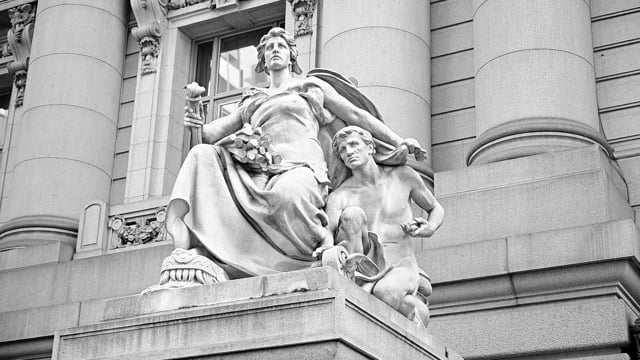
Daniel was not in attendance at the unveiling of The Minuteman. Shortly before the memorable day in which Ralph Waldo Emerson and the people of Concord welcomed Ulysses S. Grant, then president for the long-awaited ceremony, French was already on a pilgrimage to Florence where over the next period of two years he will learn from the great masters of the Renascence and from Thomas Ball, an expat and fellow New Englander living as a member of the creative milieu in Florence. As the son of the honorable Henry Flagg French, and Anne Richardson whose patrician roots could be traced back to early colonial times, Daniel was clearly in a position to afford such investment on his education, in fact it was expected of him. His previous apprenticeships with distinguished American sculptors like John Quincy Adams Ward were brief and circumstantial leaving left French the need to connect with the fundamentals of sculpture at its roots, and Florence was where he was going to make that connection. On his return to America in the summer of 1876 Daniel learned that his father had just been appointed by President Ulysses Grant as Assistant Secretary to the Treasury, a position from which he will greatly contribute to the success of his children. Two years later, his eldest son William became Secretary of the Chicago Academy of Fine Arts, known today as the Art Institute of Chicago, and Daniel was already on his way to become a prolific and acclaimed sculptor in the American school of Beaux-Arts. Daniel’s first relevant commission, other than the bust he did of his father and that other another he did of Ralph Waldo Emerson, was Peace and Vigilance, the sculptural group for the front pediment, of the Federal Customs House and Post Office in St. Louis, Missouri for which he had absolute creative freedom. It was the first of several to follow, next came Law, Prosperity and Power which French completed in Concord for the Philadelphia Custom House. American cities where at last showing signs of the architectural refinement that characterized public buildings in major European cities Particularly in Paris where Augustus Saint-Gaudens, Daniel’s most distinguished contemporary rival, had his cultural roots. In a way, Saint-Gaudens and French did complement each other by bringing to the table the traditions of Paris and Florence with a unique American flavor. In the coming years French will work simultaneously in several projects, often from different studios, either built or rented to accommodate the needs of his prolific endeavors. John Harvard (1884) the sculpture inspired by the founder of the of the famed university was one of his first in bronze, a technic he felt required further instruction, a learning experience that will ultimately take him to Paris. But before heading back to Europe, Daniel will complete The Millmore Memorial, also known as The Death and The Sculptor, the work was commissioned to mark the grave of brothers Joseph and Martin Millmore brothers, stone carver and sculpture respectively. The Millmore Memorial is perhaps one of French’s most resounding and accomplish works one in which the onlooker immediately empathize with the way in which Death approaches the sculpture, still at work to softly hinder his hand from further doing. In Paris, where the plaster cast was brough to be cast into bronze, of The Millmore Memorial was awarded a medal at Salon de Champs de Mars, only the second such award bestowed by the Parisian art world to an American. A marble copy of The Millmore Memorial was later donated to The Metropolitan Museum of Art where it remains today.
- The Butt–Millet Memorial
Washington was built to be admire and visit as one would a permanent exhibit. It doesn’t have at first glance, the cluster of accumulated decadence that make other capitals attractive in a different way. Washington is a maquette in a vitrine, a test-tube metropolis conceived as a living museum. Other than parks, and museums, the capital of the United States offers more than one-hundred and fifty monuments memorializing historical events, poets, public servants, victims of the Holocaust, soldiers, civil right leaders, and most of the wars fought by this nation in all corners of the world. Washington even has a statue to José Gervacio Artigas, father founder of the tiny, yet precious republic of Uruguay in South American. In fact, there’s no other city in the world where the nation speaks to the visitor about the glories and troubles of the past in words of stone, marble, and bronze like in the District of Columbia. Some monuments are better known that others, some may hide as much as they reveal. Amongst the least popular sculptures is the The Butt–Millet Memorial Fountain located in President’s Park, just in front of the White House. The twelve feet high column rising from the bowl of golden-brown Tennessee Marble was commissioned to celebrate the life of Archibald Butt and Francis David Millet, prominent members of the political class in Washington who drawn when the Titanic sank in the North Atlantic Ocean on 15 April 1912. Francis Millet, served on the Commission of Fine Arts and took part in the design of the National Mall, Archibald Butt, was a Major in the U.S. Army and a presidential military aide. They were a well-established couple, widely believed to have been romantically involved for decades. In the relief, Millet is represented with the figure of a woman holding a paint brush and palette, while Major Butt is represented by a man in armor and helmet, holding a shield. The architect who worked with the sculptor to erect this monument was Thomas Hasting; the sculptor, was Daniel Chester French.
- Alice Goes West
Alice: At Home With Alice Parker has been nominated to the Oficial Selection at the upcoming Bare Bones Music & Documentary Festival. Last year, Alice’s film was awarded Best Documentary at Mystic International Film Festival. The Bare Bones International Film and Music Festival was founded in 1999 by the Darkwood Film Arts Institute (DFAI) in Muskogee, Oklahoma to showcase independent motion picture projects with budgets of less than one million dollars (hence Bare Bones). The festival runs for eleven days each year in late April at several venues in downtown Muskogee. Movie Maker Magazine called Bare Bones a "small-town festival that celebrates indie auteurs, directors, screenwriters, actors and cinematographers in a big way.” In 2010, Movie Maker named Bare Bones to its list of 25 Film Festivals Worth the Entry Fee.
- Chesterwood Announces Film
Chesterwood is pleased to announce the development of “Daniel Chester French” a documentary by award-winning filmmaker Eduardo Montes-Bradley. The film will explore the life and work of the renown sculptor and will serve as an educational tool, build a worldwide audience for the French and his work, and introduce the public to Chesterwood. The film is set to premiere in the Berkshires on May 26, 2022, in commemoration of the one hundredth anniversary of the dedication of the Lincoln Memorial. "When I was approached by Dan Preston and Michael Richman, editors of the Daniel Chester French papers, with the idea of making a documentary, I had just a vague idea of who he was. I was familiar with his work, but little did I know about the man behind the monuments. As with many sculptors, French's name was living under the shadow of his accomplishments, many of which have had major historical implications.” -- Montes-Bradley. The documentary will include interviews with French scholars, including Michael Richman, the curator of the first major exhibition and catalogue of French's work, Daniel Chester French: An American Sculptor (Metropolitan Museum of Art 1976) and Lincoln scholar Harold Holzer, author of the recently published biography, Monument Man: The Life and Art of Daniel Chester French (Princeton Architectural Press 2019). Montes-Bradley filmed on location at Chesterwood as an artist-in-residence last summer. Other film locations will include Concord, MA, New York City, Washington D.C. and Florence, Italy. After its official premiere in the Berkshires, Montes-Bradley’s documentary will be distributed by Kanopy streaming to academic and public libraries. Significant support for this film has come from Morris and Alma Schapiro Fund, Jeannene Booker, Anita Heller, Elizabeth Pyle, Nancy Sheridan Kojima, Hans and Kate Morris, Joel Rosenkranz/Connor-Rosenkranz LLC, Elsie and Joel Thompson, Terry and Jay Wise, and many friends of Chesterwood. National Trust for Historic Preservation
- Beyond the Female Form
It is exceptional, to say the least, to find statues, busts or otherwise dedicated to female historical figures in America. In fact, as I’ve mention in a previous post, only six such sculptures were in place in New York until very recently. The many females form we see around the city and in fact around the country are strictly allegorical. That’s why I was pleasantly surprised when I found this bust of Mary Harris Thompson by Daniel Chester French, created in 1902, more than a decade before Joan of Arc was emplaced on Riverside overlooking the Hudson. I became even more delighted when learning who Mary Harris Thompson was, and here is a glimpse to her story from the description provided by the Art Institute of Chicago. “When Mary Harris Thompson arrived in Chicago in 1863 to practice medicine, she found a city desperately in need of medical care for women. It was obvious that the city’s two hospitals were grossly inadequate; in fact, one of them did not even accept female patients. Responding to this crisis, Thompson opened the Women and Children’s Hospital in 1865, and in 1870 she founded the Women’s Hospital Medical College, the first medical college for women in the Midwest. At the time of her death, Thompson had gained international recognition, both for being the first female surgeon in Illinois and for opening up the healthcare profession for women.”