Sorolla’s Other Spain: Social Realism and the Unraveling of Empire.
Several years ago, the legendary cinematographer Ricardo Aronovich encouraged me to study Sorolla’s paintings for what they might teach me about documentary filmmaking. I did, and soon fell under the spell of the familiar Sorolla, the master of light. Then I discovered another.
The Sorolla we carry in our imagination is a painter of sunlight. Children play in the surf, women walk along the shore, and fishermen work beside a Mediterranean whose brightness seems capable of absorbing every difficulty. Even labor acquires something reassuring in that light. His paintings invite us into a Spain of physical vitality, enduring customs, and apparent belonging.
Three paintings complicate that invitation: ¡Aún dicen que el pescado es caro! (1894), Trata de blancas (1894), and ¡Triste herencia! (1899). Here Sorolla confronts injury, exploitation, and vulnerable childhood. The people who might elsewhere populate an attractive coastal scene become the subjects of an uncomfortable examination. What does their suffering reveal about the society around them?
These paintings emerged during the troubled final decade of the nineteenth century, when social unrest and imperial decline unsettled Spain’s understanding of itself. Two precede the military defeat of 1898; the third follows it. We should therefore resist treating all three as responses to that event. They belong, however, to the climate of national questioning that the defeat intensified. Spain’s problems were already visible to those willing to look at its people.
In ¡Aún dicen que el pescado es caro!—And They Still Say Fish Is Expensive!—two older fishermen tend a young companion injured aboard their boat. Sorolla brings us into a confined space, close to the exposed body and the men attempting to help him. The sea’s pleasures have receded. We are confronted with the danger of earning a living from it.
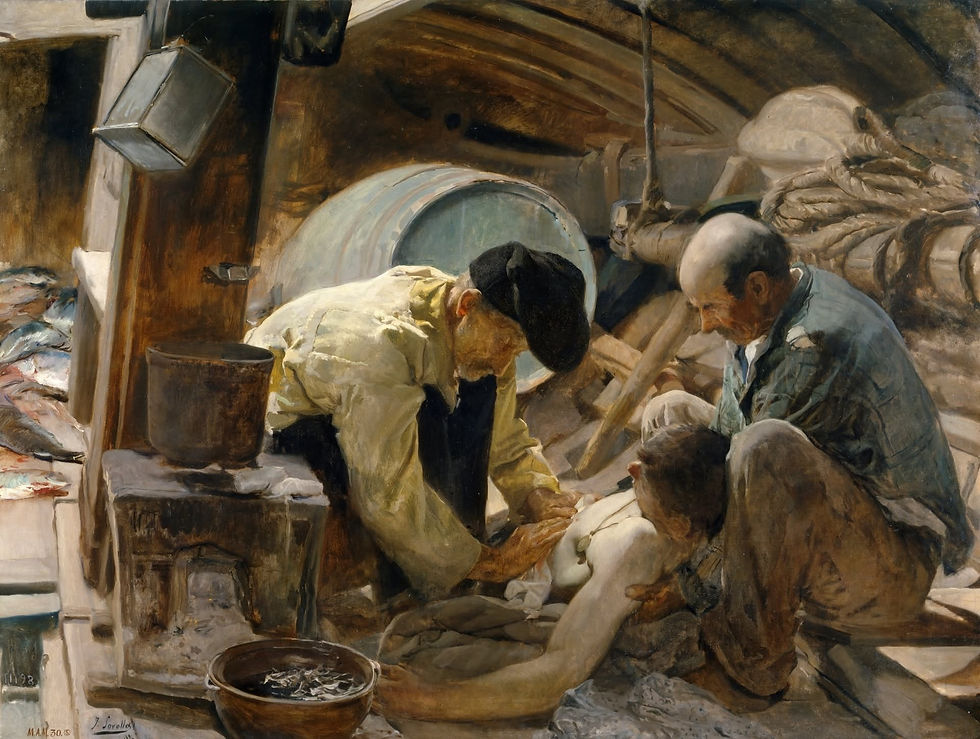
The title carries the accusation. Someone, somewhere, complains about the price of fish. The painting answers by showing a cost that never appears in the market calculation: an injured body, the possibility of death, the precariousness of a livelihood. The consumer sees a commodity. Sorolla makes us consider the person who brings it ashore.
The care between the fishermen gives the scene its emotional force. Their gestures establish a small community of responsibility. We encounter the injured youth through the attention his companions give him, and their concern becomes a measure against which the distant complaint about prices sounds shamefully inadequate.
In Trata de blancas, the setting changes to a third-class railway carriage. Four young women travel with an older woman identified by the Museo Sorolla as their procuress. Most are asleep. The museum places the painting within the social realism Sorolla practiced during the 1890s, while also emphasizing his interest in its formal construction.

There is little overt action. Exhaustion supplies the drama. Without the title, a viewer might initially see ordinary passengers resting during a journey. With it, their stillness becomes disturbing. We begin to wonder about the circumstances of their travel and the extent of their freedom.
The railway, an instrument of modern movement, offers no assurance of liberation. These women are being carried toward a destination, but movement alone does not constitute opportunity. Read beside the injured fisherman, the painting suggests another way vulnerable people enter an economy: through the availability of their bodies to the needs and demands of others.
¡Triste herencia! returns us to the shore. Painted in 1899, it depicts boys with disabilities bathing under the supervision of a religious brother. The setting brings the work especially close to the Sorolla we think we know. There are children, water, and the Valencian coast. Yet the encounter asks something different of us.
The title requires particular care. Its language of inheritance belongs to an era when theories of hereditary “degeneration” could mingle medical speculation with moral judgments about parents and children. Those assumptions should not be accepted as explanations of the boys’ disabilities. They help us understand the anxieties surrounding the painting and the burden its title places upon its subjects.

For me, the painting’s deepest question concerns what a society passes on to its children. Care and opportunity are inheritances too, as are neglect, poverty, and exclusion. But I also see in these boys a reflection of a country wounded by empire and war. Painted in the immediate aftermath of 1898, ¡Triste herencia! allows me to read its title beyond the circumstances of the children themselves: what inheritance had Spain’s imperial ambitions left to the generation coming of age amid their collapse?
This is my perception, rather than a claim about Sorolla’s intentions. I am not suggesting that the boys’ disabilities resulted from the fighting. Yet I see them as children of the empire, inheritors of losses they had no part in creating. Their physical vulnerability evokes, for me, the bodily and emotional wounds that survive a war and enter the lives of those who follow it.
If the painting carries an echo of that collective injury, it may have entered unconsciously, through the atmosphere in which Sorolla lived and worked. We cannot know. A painter need not set out to construct a national allegory for the anxieties of his time to find their way into an image. Nor must a viewer’s encounter with that image end where the artist’s documented intentions end.

The boys have individual lives beyond the national meanings we might assign them. Their disabilities do not make them emblems of a diminished people. What moves me is their exposure to circumstances beyond their control, and the responsibility their presence places upon others. Before them, the language of imperial glory feels painfully remote. What remains is the question of who will care for those left to bear its consequences.
Seen together, these works suggest a connection with the inward examination associated with Spain’s crisis at the turn of the century. That connection need not make Sorolla an illustrator of the Generation of ’98. It allows us to recognize a shared pressure: the need to examine lived conditions beneath inherited accounts of Spanish greatness.
Years later, the fourteen panels of Vision of Spain, commissioned for New York’s Hispanic Society, would assemble an encompassing panorama of regional dress, work, ceremony, and custom. Painted between 1912 and 1919, they presented a cultural world that Sorolla and his patron, Archer Milton Huntington, understood to be disappearing. Their grandeur contains an anxiety of its own—the desire to preserve a country through its traditions.
The three earlier paintings ask us to consider the people whose difficulties such a panorama cannot fully contain. What protection does tradition offer an injured worker? What future is available to an exploited young woman? What place does a community make for a child who depends upon its care?
Each painting brings social criticism into a human encounter. We must look closely at someone whose suffering might otherwise remain outside our field of vision. Sorolla’s achievement here lies in making that attention difficult to withdraw.
His sunlight remains extraordinary. These paintings make us ask who gets to enjoy it, under what circumstances, and at whose expense.
Eduardo Montes-Bradley now resides in Valencia, where he continues to devote his time to his documentary projects on Joaquín Sorolla and Rafael Guastavino, exploring the lives and legacies of two Valencians whose work reached far beyond Spain. If you enjoyed this essay, please share it, repost it, and subscribe to the blog for new essays and updates on both films.


Comments