


J.J. Lankes: Among Poets and Rebels — Robert Frost and Sherwood Anderson
Updated: May 19
One early morning in March of 2017, we embarked on what turned out to be a two-year documentary journey in search of Julius John Lankes — distinguished artist, woodcutting master, printmaker, and one of the quietly essential figures of American visual culture in the first half of the twentieth century. The film that emerged is not simply the portrait of an artist. It is the portrait of a conviction: that the pastoral, the handmade, and the rooted were worth defending against the advancing forces of the machine age — and that a man with a block of apple wood and a borrowed engraving tool could make that argument permanent.
Buffalo, 1884: A Blue-Collar Beginning
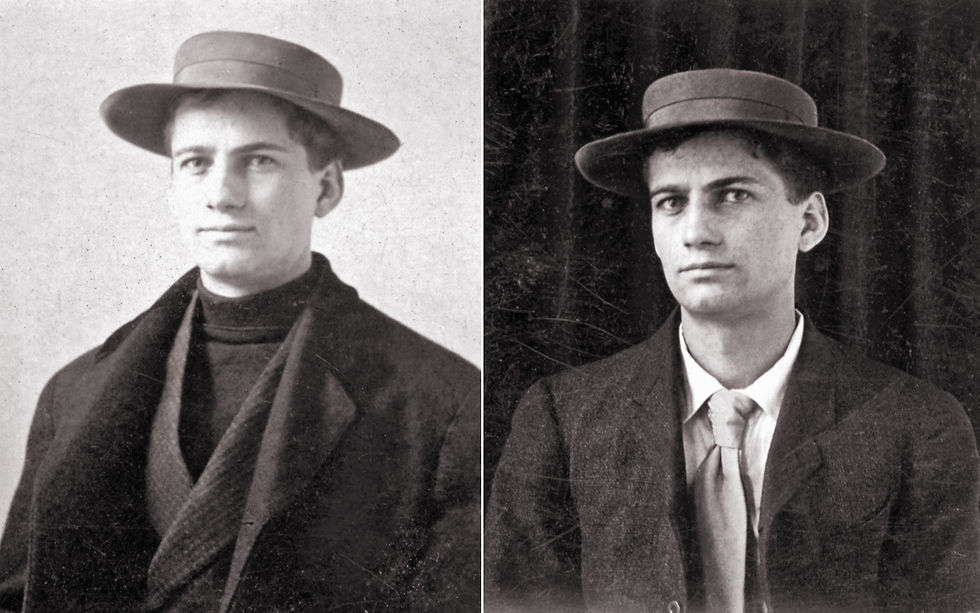
Julius John Lankes was born on August 31, 1884, in Buffalo, New York, into a blue-collar family of German ancestry. Buffalo was then one of the most prosperous and densely populated cities in the new world, its fortune built on the Erie Canal and the commercial momentum of a nation transforming itself at speed. The city's ambitions crested publicly in 1901 with the Pan-American Exposition — a World Fair extravaganza remembered today primarily because it was the site where President William McKinley was assassinated on September 14th of that year, shot by a disenfranchised worker of anarchist sympathies who regarded McKinley as the living embodiment of capitalism's threat to the American laboring class.
Lankes graduated the following year as a junior engineer from the Buffalo Commercial and Electromechanical Institute. He was entering the workforce precisely at the moment America was completing its transition from the agrarian republic of the previous century into a world-class industrial power. His first employment was as a draftsman — drawing technical transcriptions of ideas for inventions and patent registrations. It was precise, skilled work. It was not enough.
The Canoe Trip and the Artist's League
After a thousand-mile soul-searching canoe trip down the Mississippi, Lankes enrolled with the Arts Students League of Buffalo, housed in the hallways and exhibition rooms of the Fine Arts Academy. Leading the men's evening live class was Ernst Forsberg, a Canadian artist of considerable local influence and one of the forces behind the establishment of the Saturday Sketch Club — notably an organization, unusual for its era, that admitted women as members. One of those founding members was Edie Bartlett, who would become Lankes's wife.
The League's openness mattered. The exclusivity of most artist organizations of the period — regional and national alike — was a form of cultural gatekeeping that Lankes would spend much of his career resisting in one form or another. Here, the doors were open. Here, the work could begin.
Supporting himself as a draftsman at a Buffalo firm that manufactured custom sporting rifles — weapons whose wooden stocks were engraved with ornamental designs — Lankes borrowed an engraving tool from his employer in 1917 and took a block of apple wood. He cut a single design. The medium found him.
The Woodcut and Its World
The art form Lankes committed himself to was not a provincial hobby. Woodcut and printmaking were, in the second decade of the twentieth century, charged with political and artistic electricity. In Europe, the tradition of German Renaissance engravers was being reclaimed as a vehicle for radical expression. In Latin America, the generation of Guadalupe Posada was embracing woodcutting to explore the psyche of the Mexican Revolution. The woodcut was a democratic medium — reproducible, distributable, available to readers of labor newspapers and small literary magazines as readily as to gallery collectors.
Lankes was drawn to progressive-minded intellectual circles and contributed to left-wing publications, including those associated with the Communist Party. His affinities were for the working masses, for the Liberator and the figures around it, for the Harry Recht clubs and the radical networks that, in the late teens and early twenties, seemed to be reshaping what America might become. His contemporary Rockwell Kent moved in the same orbit — Kent would eventually leave much of his personal art collection to the people of Russia.
But Lankes's alignment with collectivism was always more temperamental than ideological, and it was short-lived. The solution he ultimately arrived at was his own: an iconoclastic individualism that would define the long middle decades of his career. He turned away from political allegiance and toward pastoral devotion — toward the land, the rural worker, the agrarian republic that industrialization was steadily erasing.
One of his most significant early prints was a reinterpretation of Jean-François Millet's Man with a Hoe — a painting that had generated accusations of socialist provocation in Paris when it first appeared. In rendering the same subject, Lankes expressed a parallel concern for the fate of the American rural worker. The image was noticed by a reader who would change the course of his life.
Robert Frost and the Friendship That Defined a Career
The reader was Robert Frost. A print published in the Liberator caught Frost's attention, and what followed was one of the most significant artist-poet collaborations in twentieth-century American culture. Of the more than 1,300 woodcuts Lankes is known to have produced in his lifetime, 125 were inspired by or directly connected to Frost's work. Frost felt that Lankes's depictions of the rural New England landscape were a graphic representation of his own poetry — the same characters, the same pastoral scenes, the same unsparing attention to the particular textures of working life in agrarian America.
In August 1924, Lankes made his first visit to Frost's farm in South Shaftsbury, Vermont, traveling with Charles Burchfield and William Schanhaarst. On the way they stopped at Woodstock, New York, to visit George Bellows, and then called on Bolton Brown, already well known for his lithography. When they finally arrived at the farm, Frost killed the fatted watermelon for them to share, and they slept in the barn on freshly mowed hay.
While Frost talked, Lankes sat and sketched. He always did. Almost every visit to South Shaftsbury produced drawings that would later become woodcuts — among them a rendering of the railroad station where Lankes had arrived that first afternoon, down the hill from the farmhouse that is today the Robert Frost Stone House Museum.
The friendship endured for decades, through correspondence and visits and collaboration on editions and broadsides. It was rooted in shared ideological commitment to the vision of an agrarian America — not a sentimental postcard version, but a specific, laboring, weather-worn world that both men understood to be under mortal threat.
Charles Burchfield, Sherwood Anderson, and the Work of the 1920s
Burchfield had met Lankes in 1922, when Burchfield was designing wallpaper for the M.H. Birge Sons Company. When Burchfield moved to Gardenville in 1925 — where Lankes was already living — the two became neighbors and collaborators. Their working method was unusual: Burchfield would draw the design, the block would go to Lankes for carving, and they would exchange proofs back and forth, making decisions together about alterations. Alongside prints documenting American small-town life, which both men loved, they produced a series of religious prints that were, characteristically, more cosmic and natural than devotional — because Burchfield was an atheist or agnostic, and Lankes was one of the very few people to whom he could reveal that honestly. The social pressure to conform was considerable.
In the spring of 1925, Lankes traveled to Europe, arriving in Germany at the height of the Weimar Republic — a period of cultural ferment balanced above political tensions that were already tilting toward catastrophe. He was there not to engage with the present but to recover the past: to sketch ancestral memories he would later carve in wood. He also visited Italy, France, and the Netherlands before returning to the United States.
Upon his return, Lankes settled in an unlikely place: Hilton Village, a small coastal town in Virginia on the James River. He had left progressive New England for the provincial South of Confederate veterans and Jim Crow. What rural Virginia offered, paradoxically, was a landscape that in many ways predated the industrial revolution — a world where machines had not yet fully replaced manual labor, where the life he wanted to document still existed in visible form.


It was in Virginia that Lankes's friendship with Sherwood Anderson took shape. Anderson had moved to the state and built a country house near the village of Troutdale, some twenty miles south of Marion. Their collaboration centered on Perhaps Women — a collection of essays in which Anderson argued that women would reassert the human qualities that men had surrendered to the demands of the mechanized industry. Lankes interpreted Anderson's central idea with an image of a woman on horseback leading a man riding a mule. His frequent visits to the Troutdale cottage produced a significant body of woodcuts representing the Appalachian landscape and the Blue Ridge Mountains.
John Henry and the Defeat of Manual Labor
The collaboration with Roark Bradford brought Lankes into direct engagement with the African American working tradition. Bradford had mined the veins of Black American folk culture for literary material in the manner Mark Twain had drawn upon the tales of the Mississippi — and for his novel about John Henry, the legendary steel-driving man destroyed by the steam drill, he asked Lankes to illustrate.

It was, as the film makes clear, a recurrent and entirely coherent theme. Lankes's collaboration with Frost was rooted in the shared commitment to the utopian ideal of the agrarian republic. His work with Anderson expressed hope that women might redeem men from their capitulation to the machine. His illustrations for Bradford's John Henry confronted the most brutal dimension of the same argument: the displacement and exploitation of manual labor, and the particular vulnerability of Black working men in a system designed to use them as cheap labor.
John Henry drives his hammer until he dies. The steam drill wins. Lankes understood the ending.
Wells College and the World at War
In 1932, Robert Frost intervened in Lankes's fortunes in the practical, decisive way that characterized their friendship. Sensing that Lankes was struggling financially, Frost learned of an opening for an art professor at Wells College, a small institution on Lake Cayuga in the Finger Lakes region of New York. Lankes joined the faculty and held the position for seven years.
The landscape was familiar — upstate New York, not far from Buffalo — and the political and intellectual atmosphere was more congenial than the provincial Virginia he had left. He was back among people whose value systems more closely matched what he had grown up with. He was shaping the minds of young, receptive students.
But academic life left him uninspired, and the world's headlines were darkening. The decade that began with the Depression was ending with Europe at war again. It was at this point that Lankes became romantically involved with a woman named Mildred Sherman — a rupture that delivered a final blow to his long marriage to Edie.
NASA, McCarthyism, and the Last Chapter
In the postwar years Lankes secured a position as technical illustrator with the National Advisory Committee for Aeronautics — the federal agency that would become NASA. The job brought financial security after years of precarious independence. It also brought him full circle: back to the drawing board, back to the draftsman's table he had left forty years earlier when the canoe trip and the artists' league opened a different door.

During this period, he continued to work on his Pennsylvania Dutch-born series, which he considered his crowning achievement.
The Cold War, however, was conducting its own purge. The anti-communist crusade targeted federal employees with any history of sympathies or associations with the Communist Party — and Lankes had those associations, however distant and however temperamentally rather than doctrinally rooted. He was dismissed from NASA. Rockwell Kent, his old contemporary, apparently suspected that past communist leanings were the cause.
The late work of a man who had spent his career documenting the defeat of the handmade by the machine was now complete: he had been defeated by the machine of the state.
The Last Visit

Lankes had suffered a severe stroke. He was in a nursing home, barely able to speak, with little movement in his upper body. Frost came to Chapel Hill for his annual reading and, knowing Lankes was gravely ill, went to the nursing home to see him.
They looked at each other.
"Goddamn it all," said Frost.
"Goddamn it all," said Lankes.
Frost touched Lankes's cheek, turned around, and left. It was the last time they saw each other. Lankes died a few weeks later.
The Argument in Wood
Our two-year journey in search of Julius John Lankes ended where it had to: in the recognition that the more than 1,300 woodcuts he left behind constitute not merely a body of work but a sustained argument — made in apple wood and ink, in the ancient slow medium of the hand — against the forgetting that industrialization demands.

He was a Yankee who went south. A progressive who became an individualist. An engineer who became an artist. A federal employee who was fired for his past. A man who spent his career documenting the defeat of manual labor and who was himself, in the end, defeated.
But the prints remain. And in them, the agrarian republic he refused to stop believing in remains too visible, particular, and permanent in a way that no steam drill and no government purge has managed to erase.
J.J. Lankes: Yankee Printmaker in Virginia is a Heritage Film Project production directed by Eduardo Montes-Bradley and Soledad Liendo.
Support the Documentary Film Fund
If this story resonates with you, please share it, leave a comment below, and subscribe for updates.
Our documentary work is made possible through the support of the Documentary Film Fund, a 501(c)(3) nonprofit dedicated to bringing stories like this one to the screen. Your contribution — at any level — helps preserve and share the cultural legacies that might otherwise be lost.
👉 Support the work: please visit the Documentary Film Fund link and donate if you can.


Comments