


White: A Season in the Life of John Borden Evans. A documentary by Montes-Bradley. North Garden, Virginia, 2014
Updated: May 4
White: A Season in the Life of John Borden Evans (2014) is a Heritage Film Project documentary written, directed, and shot by Eduardo Montes-Bradley. Filmed entirely during one winter on the foothills of the Blue Ridge Mountains, the thirty-minute biographical sketch follows the painter John Borden Evans and his wife, the designer Beth-Neville Evans, through the cold, isolated months of their thirty-third year in the same farmhouse in North Garden, Virginia.
The film won Best Documentary at the Richmond International Film Festival in 2015, Best Documentary at the 4th International Documentary Festival of Ierapetra, and was an Official Selection of the Virginia Film Festival.

The project began with a conversation in Evans's atelier in North Garden, where he works year-round. The original idea was a four-season portrait. By the second visit, in deep winter, the filmmaker had concluded that the picture was already complete. Cold, snow, isolation, and the rhythms of life on the foothills of the Blue Ridge had given the documentary its subject and its title.
A farmhouse, thirty-three winters
John and Beth-Neville moved into the farmhouse — an empty house that had belonged to her great-uncle — when they were twenty-four. She was pregnant. Both of their children were born in the front room. They have been there ever since.
The first years were spent winterizing a building that had let snow blow in across the dining room table. The renovations have never really stopped. As Evans observes in the film, the work resembles his own painting practice: a long process of correcting earlier mistakes until something feels, for a moment, right.
Both John and Beth-Neville were raised as the children of Presbyterian ministers. Their fathers worked at the same office at the headquarters of the Southern Presbyterian Church in Atlanta, which is how the families came to know each other long before the couple themselves ever met. They sing together in the church choir. They cook three meals a day in the same kitchen. They heat the house with a single wood stove they bought in the U-Haul on the way to North Garden — now in its thirty-third winter of service.
A painter of remembered nights
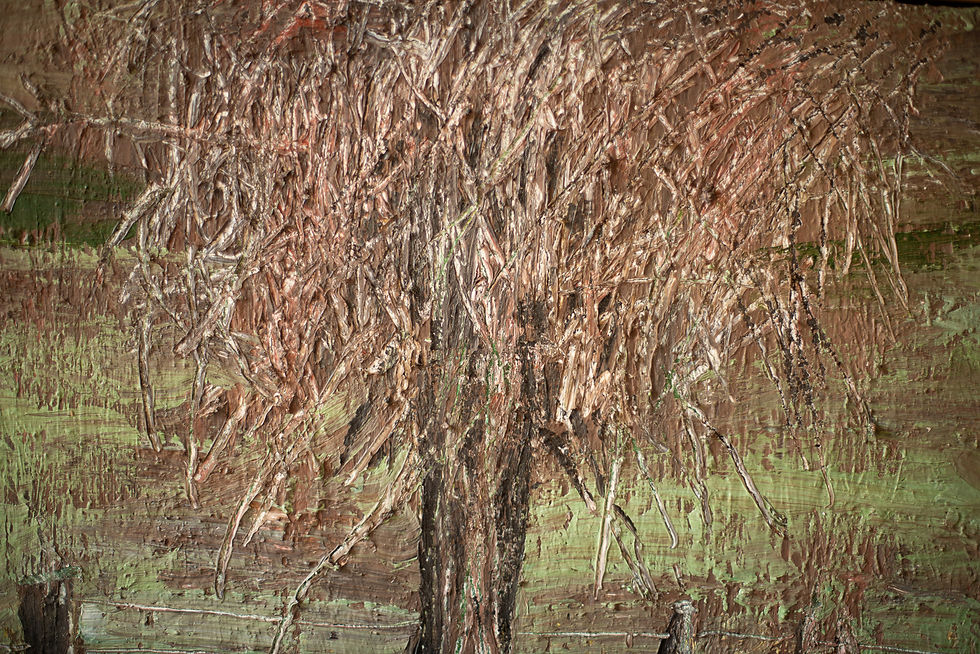
Evans's canvases are built up in thick layers — a slow accumulation that he sometimes accelerates by writing words directly onto the surface to get started. One painting in the film is inscribed with the letters G L F Y — glorify God, the answer to the first question of the Presbyterian catechism: What is the chief purpose of humankind? To glorify God and enjoy God forever.
Many of his paintings are, in his own description, night scenes — though they are not painted at night. They are painted from memory, and memory does something to the dark that the eye does not. In memory, the sky is blue even though it is really black. The stars take on color. The cows turn out to be every color but the one they were. It's the way it's the story you remembered it to be, he says, it's not the way it really.
The film makes a quiet case for winter as the better season for this kind of painting. With the foliage gone, the eye sees through the branches to the next field, and the next. The bare structure of the landscape is finally visible. Evans paints what is in front of him from a clearing in the cedars near the house, then carries the work inside to finish.
About the title — Evans is not interested in white as a moral category. He uses more white than any other color because most painters do; because it can be bought by the gallon; because a thick layer of it can be sanded down or scratched into for surface. I don't think of white in terms of good and evil, he says, or white being the better color than black. The film honors that pragmatism while quietly noticing what white does to the rest of the picture.

Two practices, one house
Beth-Neville is a designer and maker of clothing — once the proprietor of The Consummate Clothier, where she made wedding dresses, suits, and bespoke garments. (Her client list, as friends of the film have noted, has included the writer Tom Wolfe.) After years of directing a nonprofit that worked with a town in Guatemala, she has returned to designing and making clothes for individuals, joined now by an apprentice.
The film draws an unforced parallel between her craft and her husband's. Both demand repetition and patience; both are built up in layers; both depend on the maker knowing what is coming several stages ahead. As she puts it, the whole point of a handmade jacket is that it hangs level and plumb on the body — like a building. The same disciplined geometry runs through the way Evans builds a canvas.
A shared life
Around the painting and the tailoring, the film catches the architecture of an ordinary day: bees in the hive on the half-warm side of the colony, three meals shared at the same kitchen table, a favorite skillet of greens cooked with a head of garlic and a splash of soy sauce, choir practice, the wood stove, the snow. Singing, Evans says, is breathing with sound. The film treats it that way, too.
Selected praise
White: A Season in the Life of John Borden Evans is a close look at an intriguing couple who chartered their own course and made you envious. — Julian Bond, Washington, DC
The whole thing is so skillfully woven together — John's quiet voice, and silence, and then the music. It creates a wonderful, wondrous mood. The stars. And the cows. And the trees. — Alice Parker, Composer, Conductor. Massachusetts.
The cinematography is stunning. The notion that the cinematographer can compose an artwork that includes the painting, the artist, and the artist's life is a compelling one. By reaching beyond the artwork to the life, Montes-Bradley also enables the viewer to consider what of the artist's life gets into the art and what doesn't… The director's use of shape-note singing keeps that theme alive as the film progresses. This one is best, I think, of the Montes-Bradleys that I've seen — not a wasted frame. — Jeffrey Plank, University of Virginia
The treatment of each scene mirrors the austere choice of a monastic life in accord with the silence of art and its spirituality. The cautiously crafted composition and the sensible use of light blend film and theme as one. A work of art within a work of art. — Eugenio Cuttica, Painter, Long Island, New York
My first impression is BRAVO, and my second is superb. The camera work is exquisite, and it captures something important about John as well as Beth-Neville. — David A. Maurer, The Daily Progress
A lasting portrait
In the director's own framing, White is about an artist and a way of life; about a farm in a place in Virginia; about food and God; about love, water, trees, and the relationship between time and oneself. Above all, it is a film about an artist named John Borden Evans.
More than a decade after its premiere, White remains one of the quiet centerpieces of Heritage Film Project's catalogue of American artists — a film that, like the canvases at its core, is built one patient layer at a time. Watch White: A Season in the Life of John Borden Evans (2014) on Alexander Street Press and Kanopy Streaming.
This film was produced by Heritage Film Project with the support of the Documentary Film Fund, a 501(c)3 nonprofit organization. If this story resonates with you, please share it, leave a comment, and subscribe for updates on new and forthcoming portraits.


Comments