


A New Vision of Spain
In the aftermath of the Spanish-American War, and of a campaign by the yellow press that had portrayed the old empire as backward, cruel and exhausted, an American philanthropist set out to construct another image of Spain—one more attuned to modern times.

There is something almost paradoxical about the Hispanic Society of America standing where it does, on Audubon Terrace in Upper Manhattan. It is a repository of Spanish art and culture built not in Madrid, Seville or Barcelona, but in New York—and conceived by an American at a time when Spain’s reputation had reached one of its lowest points.
The Spanish-American War had ended in 1898, and throughout the conflict Spain had been portrayed as the decrepit remnant of an old empire: corrupt, cruel, fanatical, incapable of governing its colonies and stranded somewhere outside modernity. And let’s not forget Catholic. Since nations are easier to fight once they have been reduced to characters, caricature became instrumental in promoting these ideas.
It was around then, or just a few years later, that Archer Milton Huntington (1870–1955) began to promote a different idea of Spanish culture. In 1904, he founded the Hispanic Society of America. His ambition went far beyond assembling a collection of remarkable objects. Books, manuscripts, paintings, sculpture, archaeology and scholarship would eventually help establish in New York a cultural institution devoted to portraying Spain in a different light. Literally.\
Within barely a decade, the American public was being presented with two radically different constructions of Spain.
One belonged to the newspaper caricaturists of 1898: priests, bulls and violence; medieval backlash in the face of modern transformation; oppression, Old World bureaucracy and centralized colonial power. The works!
The other was taking shape on Audubon Terrace, on the northwestern edge of Manhattan.
Enter Sorolla
Huntington found a powerful instrument for this alternative vision in Joaquín Sorolla, a native of Valencia on Spain’s Mediterranean coast. Already successful and internationally renowned, Sorolla offered Huntington something valuable: a painter who spoke in the increasingly universal language of modernism, and in whom Huntington recognized the visual vocabulary he was looking for—a means of reintroducing Spanish art to America while countering the darker aesthetic through which Spain had so often been imagined.
His paintings moved.
Children at play. Ocean surf. White linen at the mercy of the seaside wind. Elegant women in hats. Fishermen pulling boats onto the Valencian shore, bringing in the fresh catch from the sea. Sunlight bouncing from wet bodies.
His Spain could be ancient in its customs, but Sorolla’s way of seeing it was emphatically new. Gone were the dramatic undertones so readily associated with Goya, or the composed stillness of an earlier Spanish tradition. Sorolla’s world moved. And, perhaps most importantly, his figures were not looking at us. We were looking at them.
Huntington understood the power of what he had found.
In 1909, the Hispanic Society organized a major Sorolla exhibition. The response was extraordinary: nearly 160,000 people came to see it, and Sorolla became a sensation in America.
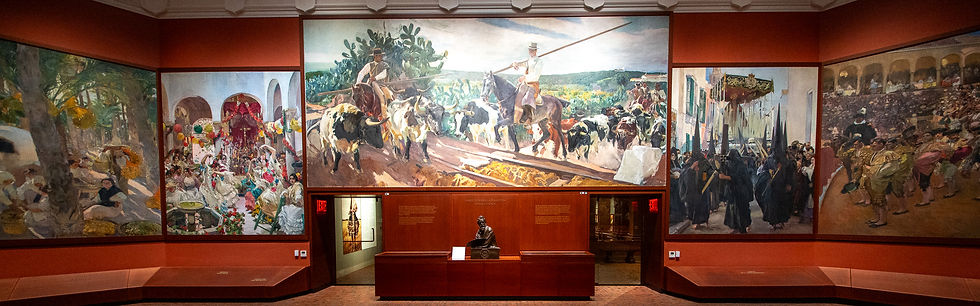
The success of that first encounter between New Yorkers and this other vision of Spain led Huntington to something far more ambitious. He commissioned Sorolla to create a monumental panorama for the Hispanic Society—a project that would consume much of the painter’s remaining working life.
Huntington was asking Sorolla to paint Spain. Nothing else, nothing less.
But how?
Spain was undergoing profound transformation. The empire that had taken shape four centuries earlier, with unification, the expulsion of Jews and Muslims, the encounter with the Americas and the extraordinary expansion that followed, was no more. In 1898, Spain had lost the remnants of its once enormous overseas empire. What remained was not simply defeat but an intellectual crisis. A generation of writers and thinkers was already confronting what became known simply as El Desastre—the Disaster.
And now Huntington was asking Sorolla to make a portrait of that Spain.
How does one paint a nation questioning its own identity? How does one preserve traditions while acknowledging that the world sustaining them is no longer there? How does one paint fishermen hauling their catch, women crossing a windswept beach, celebrations, costumes and work without turning the country into a museum of itself?
How, in the aftermath of the Disaster, does Sorolla paint Spain and still retain its light?
Sorolla’s answer was a road trip.

He crossed Spain searching for landscapes, costumes, rituals, occupations and people. He worked in Castile, Navarre, Aragón, Catalonia, Andalusia, Galicia, Extremadura, the Basque Country and, inevitably, his native Valencia. He sought models and made studies from life; much of the enormous undertaking was painted outdoors.
The correspondence between the artist and his wife, recently shared with me by his great-granddaughter Blanca Pons-Sorolla, provides an extraordinary window into the tensions pulling him in one direction and another: the exhaustion of the work, his longing for Clotilde and, at the same time, his excitement at what he was finding.
From El Roncal, in Navarre, in August 1912, Sorolla wrote to Clotilde that their son Joaquín would have enjoyed being there, because he would have discovered “una España admirable, digna y hermosa.” An admirable, dignified and beautiful Spain.
There is much more in this correspondence that I hope to explore in the film now in progress, and I suspect Blanca will have considerably more to add.
Vision of Spain appears documentary, but every representation of a nation is also an invention, and that makes it particularly interesting to me. Sorolla chose which regions would stand for Spain, which costumes would identify them, which ceremonies mattered, which occupations deserved monumental treatment and which fragments of everyday life could carry the weight of national identity.
There is an additional paradox.
Huntington and Sorolla were attempting to offer America a multilayered understanding of Spain and Spanish culture—something Americans might still benefit from today, given the opportunity—yet Sorolla frequently looked toward precisely those things that appeared least modern: regional dress, religious ceremonies, fishing communities, dances, folklore and agricultural traditions.
Both men understood that much of what Sorolla was recording was already fading away. Disappearing. So this new vision of Spain was not a rejection of the old. It was something subtler.
It argued that tradition and modernity could share the canvas.
Spain Comes to New York
Sorolla completed the final panel in 1919. He never saw the complete cycle installed in New York. A stroke incapacitated him the following year; he died in 1923.
The Vision of Spain gallery opened at the Hispanic Society in 1926. By then, something remarkable had happened.

Landscapes, ceremonies, costumes and people gathered from across Spain had been transported across the Atlantic and transformed into an architectural environment in Manhattan.
An American had commissioned it. An artist from Valencia had painted it. New Yorkers could walk inside the monumental canvases, inhabit the scene. It was—and still is—almost theatrical.

There is a temptation to describe this simply as cultural preservation. But I think Huntington’s ambition was more interesting than that. The Hispanic Society was not merely storing Spain’s past. It was participating in the construction of Spain’s image abroad.
A Valencian Constellation
Sorolla was hardly an isolated Valencian phenomenon. Among his friends was the sculptor Mariano Benlliure, another artist whose work would enter Huntington’s orbit. I recently visited his house-museum in Valencia. But it was yet another Valencian friend whom Sorolla would bring directly into this story: Vicente Blasco Ibáñez.
That connection changes the direction of our journey. Another bend in the road.
Blasco belonged to Sorolla’s Valencia. His house stood on the beach at Malvarrosa, facing the Mediterranean and the same coastal world that appears again and again in Sorolla’s paintings.
Painter and writer were not simply two famous Valencians who happened to become successful abroad. They knew one another well. They were friends. And when Huntington’s desire to present a new vision of Spain moved beyond painting, Sorolla led him to Blasco Ibáñez.
That gesture is enormously revealing. Huntington’s project could not be accomplished through images alone. Spain also needed a voice.
Sorolla could show Americans Spain.
Blasco put words into the picture.
And so one Valencian leads us to another.
From a gallery on Audubon Terrace, we return to the Mediterranean, to a house beside the beach at Malvarrosa, and to a writer who would soon cross the Atlantic and discover an America already fascinated by his books.
But that is the next chapter: another story, one that would eventually intersect with the careers of Rudolph Valentino and Greta Garbo.
A story worth waiting for.


Comments