


Vicente Blasco Ibáñez: The Valencian Who Swept New York Off Its Feet
- 18 hours ago
- 6 min read
Before Rudolph Valentino danced his first tango on screen, and before Greta Garbo turned her face to an American camera, a writer made in Valencia created the stories that ignited their starlight. His name was Vicente Blasco Ibáñez (1867–1928) — a turn-of-the-century mass-media phenomenon before the term existed.
Blasco Ibáñez was a journalist, the founder of a newspaper, a politician, an activist, a traveler, and a public figure whose life often seemed as dramatic as his fiction. His early novels portrayed the fishermen, farmers, merchants, and working communities of Valencia. But he later turned toward stories of greater international appeal filled with war, desire, ambition, and social upheaval — strong characters, vivid settings, sweeping emotions, perfectly suited to the emerging machinery of mass culture.
Two details of that life matter especially here. In 1898, when the explosion of the Maine pushed Spain into war with the United States, Blasco Ibáñez was no bystander: from the pages of his newspaper El Pueblo he campaigned furiously against the war in Cuba, in articles so incendiary they nearly brought him to trial while he sat in the Cortes. The catastrophe that would force Spain to reinvent its image abroad was one he had lived — and fought — from within. And the artists who carried that reinvention across the Atlantic were his friends: he frequented Joaquín Sorolla's studio in Madrid and had been close to the Benlliure family since his Italian exile. Sorolla's light, Benlliure's bronzes, Blasco's stories — not parallel careers, but a single circle.
In a certain way, he anticipates the modern global writer: author, eyewitness, celebrity, and media property all at once. One thinks of Hemingway — not as a comparison of literary styles, but as a phenomenon, a lifestyle. Both understood that in a world whose frontiers were narrowing, a writer could no longer be only a writer: he was a correspondent, a brand, a face in the newsreels, a name attached to films. Blasco Ibáñez lived that model a generation earlier, and lived it first.
The decisive moment came in New York
E. P. Dutton published the English translation of The Four Horsemen of the Apocalypse in 1918. The following year it became the number-one bestselling novel in the United States — an almost unimaginable feat for a work in translation.
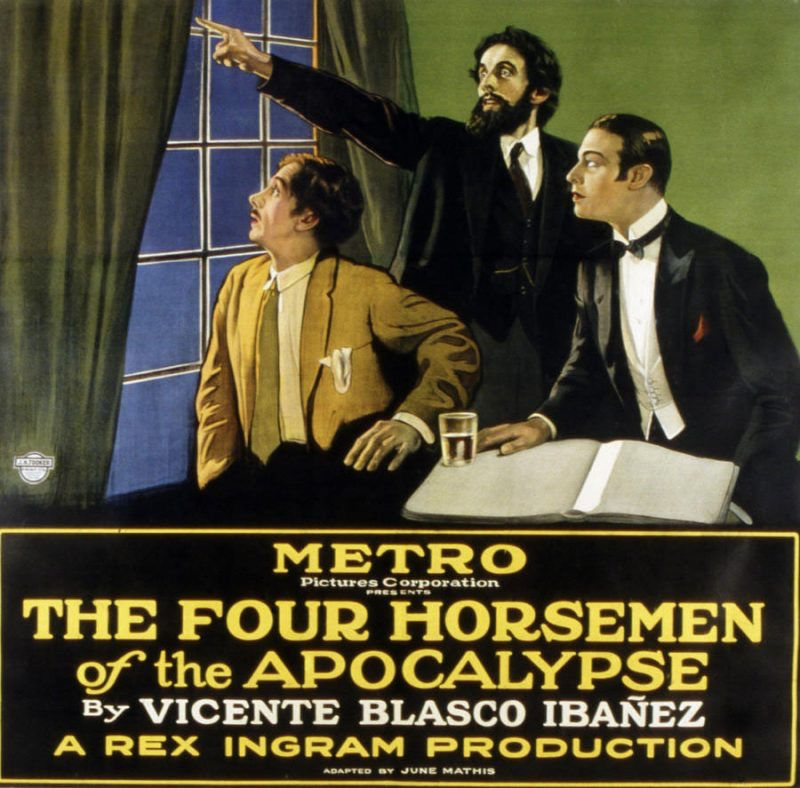
When Blasco Ibáñez stepped off the ship in the autumn of 1919, he was no longer simply a visiting Spanish author. He was the man behind the book Americans were reading everywhere. Did the young Hemingway read it? There is no letter that says so, but there hardly needs to be: in 1919 the novel was unavoidable, on every parlor table in the country. The title itself entered the American language — a few years later, sportswriter Grantland Rice would baptize Notre Dame's backfield "the Four Horsemen," and every reader got the reference instantly. That is what total cultural penetration looks like.
His American lecture tour began at Columbia University's Horace Mann auditorium on Broadway, where he spoke on Spain's influence on human progress, and continued through Boston, Buffalo, Baltimore, Philadelphia, Pittsburgh, and Chicago.
Consider the New York that received him. Prohibition was months away; the Red Scare was in full fever; women were about to vote. Al Jolson was singing a young George Gershwin's "Swanee" on Broadway — Gershwin's Rhapsody in Blue would follow at Aeolian Hall in 1924 — and uptown, the Harlem Renaissance was gathering its voice. The skyline was still crowned by the Woolworth Building, with the great setback towers of the twenties waiting in the drafting rooms. And in a Bronx studio, the Piccirilli Brothers were at that very moment carving Daniel Chester French's colossal Lincoln for the memorial in Washington. The immigrant artists were still shaping the city that never sleeps; Blasco Ibáñez arrived to join them. Across the Atlantic, meanwhile, the old world kept darkening — Mussolini would march on Rome within three years. The forces Blasco had written about were not finished.
The Four Horsemen, Valentino, and the birth of a screen idol
Blasco Ibáñez had set his great drama against a world at the brink — a conflict pulling in nations and empires, and with them, families. The Four Horsemen of the Apocalypse tells of one such family: relatives who share the same blood find themselves on opposing French and German sides when the war begins. It was a story about nationalism, family disintegration, and the forces of conquest, war, pestilence, and death overtaking a civilization — and for American readers, absorbing the human cost of the war, it challenged the sense of security built over a century of nation-building. Its timing could hardly have been more powerful.

The novel's success led Metro Pictures to an extraordinarily ambitious adaptation, directed by Rex Ingram and starring a relatively unknown young actor: Rudolph Valentino. As Julio Desnoyers, Valentino danced the tango, pursued a forbidden romance, and transformed from irresponsible playboy into tragic soldier. The film premiered in New York on March 6, 1921, became one of the great commercial successes of the silent era, and turned Valentino into a global screen idol — a new kind of male celebrity: elegant, sensual, foreign, emotionally expressive.
Blasco Ibáñez had not merely supplied Hollywood with a plot. His story helped create a new model of mass-media fame. And the relationship between author and industry became personal: Rex Ingram was among the guests received at Fontana Rosa, the villa in Menton where Blasco had built himself a private screening room — a novelist with his own cinema, entertaining the director who had made his book into the year's biggest film.
Blood and Sand: Valentino conquers New York again
His influence continued with Blood and Sand, the story of Juan Gallardo, a poor young Spaniard who rises to become a celebrated bullfighter. Fame brings him wealth, status, and a dangerous affair; it also leads him toward destruction. Blasco knew the story's cinematic power better than anyone — because he had already filmed it himself: his own screen version of Sangre y arena premiered in Paris in April 1917, five years before Paramount's. Hollywood did not discover Blasco Ibáñez; it caught up with him. A theatrical adaptation opened in New York in 1921, and the following year Paramount released the film version starring Valentino.

The combination was irresistible: America's most famous romantic idol playing a matador in a story of sex, celebrity, danger, and death. The Latin Lover stereotype was set for decades to come. The film generated songs, advertisements, imitations, and parodies; Valentino's image circulated through newspapers, magazines, photographs, and promotional cards. Blasco Ibáñez's Spanish tragedy had become raw material for the rapidly expanding American celebrity industry.
There is an older echo here. Nearly a century earlier, Washington Irving's Tales of the Alhambra had given Americans their first romantic Spain — moonlit, Moorish, legendary. Blasco offered the modern counterpart: a Spain of flesh, ambition, and mortal risk. And the ground he cleared would soon be claimed by another: when Hemingway gave American letters the corrida in The Sun Also Rises and Death in the Afternoon, he was writing for an audience whose appetite for the bullring Juan Gallardo had already whetted. The young modernists seldom acknowledged their debts to bestsellers — but the debts were real.
Once again, a Valencian writer stood behind one of the defining images of the silent screen.
The Torrent: the arrival of Greta Garbo
A few years later, another Blasco Ibáñez story introduced American audiences to a very different legend. His Valencian novel Entre naranjos became MGM's The Torrent — the story of a young woman of humble origins who, separated from the man she loves, leaves Spain and becomes a celebrated opera singer. The leading role went to a Swedish actress named Greta Garbo. Her next American film, The Temptress, would also be a Blasco Ibáñez story — his novel La tierra de todos. Garbo's Hollywood career opened with a Valencian double bill. The rest is history.
The Torrent was Garbo's first American film. It premiered at New York's Capitol Theatre in February 1926 and demonstrated that MGM's new European actress possessed an extraordinary screen presence. Her performance already contained the qualities that would define her: independence, mystery, emotional restraint, an apparent distance from the world around her. As with Valentino, a Blasco Ibáñez story provided the setting in which an unfamiliar performer could become a distinctly modern celebrity.
There were other American adaptations of his work. But these three connections are sufficient to reveal the scale of his influence: The Four Horsemen of the Apocalypse helped create Valentino the international idol; Blood and Sand consolidated his power over American audiences; and The Torrent introduced Garbo to Hollywood.
He remained, to the end, the agitator from Valencia. From exile he stood openly against the dictatorship of Primo de Rivera — combative pamphlets, a dissident review — knowing the stand would cost him the Real Academia and, in all likelihood, a Nobel Prize. He died on the French Riviera in January 1928, one day short of sixty-one, and Spain could not yet receive him. It was only in October 1933, under the Republic he had spent a lifetime imagining, that his remains crossed to Valencia — aboard the battleship Jaime I, escorted by French destroyers — where the President of the Republic and a multitude without precedent met the coffin at the port. The man of crowds drew his greatest crowd last.
Before Valentino tangoed, before Garbo turned toward the light, there was a man from Valencia writing the script.


Comments