


The Images That Taught Spain to Hate Jews
On religious imagery and medieval prejudice
I was born a Jew in Argentina, spent most of my adult life in the United States, and now find myself living in Valencia, a Mediterranean city whose Jewish past is almost invisible to the casual observer.
My first encounter with the accusation of Jewish responsibility for the death of Jesus came in third grade in Buenos Aires. Three classmates approached me, visibly upset by something they had learned in catechism: “You killed Jesus.” By “you,” they meant the Jews, and therefore me. This was bewildering. My Marxist parents embraced no religion, and I had little awareness of what being Jewish meant. Jesus was equally unfamiliar to me. My classmates moved swiftly from accusation to blows, leaving me bruised, with a bleeding nose and a question I could scarcely begin to formulate: Who were “we,” and why would we have wanted to kill this Jesus?

Decades later, now momentarily living in Valencia, I find myself returning to that childhood bewilderment with different questions. How had such an accusation traveled across centuries and an ocean to reach a Buenos Aires classroom? And what might this city reveal about the world in which it had taken hold?
Valencia has no shortage of monuments to its past. Roman foundations, Islamic walls, Gothic churches, Renaissance palaces, and modernist façades compete for attention. Yet the Jewish community that once occupied a substantial part of the medieval city has left remarkably little that an uninformed visitor might recognize. It is a curious experience to arrive somewhere unfamiliar and discover that its history touches your own—and that so much of what might help you understand that connection lies concealed beneath centuries of ordinary life.
It is a curious experience to arrive somewhere and discover that part of one’s own remote history has been concealed beneath centuries of ordinary life. Valencia has no shortage of monuments to its past. Roman foundations, Islamic walls, Gothic churches, Renaissance palaces, and modernist façades compete for attention. Yet the Jewish community that once occupied a substantial part of the medieval city has left remarkably little that an uninformed visitor might recognize.
I recently met Marilda Azulay Tapiero, and architect and scholar whose research has contributed to our understanding of Valencia's Jewish past, for coffee at Plaza del Patriarca, in the heart of the city's former medieval Jewish quarter or judería. There was something unsettling about discussing the disappearance of an entire community in a square where its presence is now so difficult to imagine.
The conversation left me wondering not only what happened to Valencia’s Jews, but how their Christian neighbors had come to regard them with such hostility.
The answer, I am beginning to understand, cannot be found in political decrees or religious disputes alone. It must also be sought in the images that surrounded medieval Christians: paintings, altarpieces, illuminated manuscripts, sculptures, and the visual narratives through which the Church communicated its understanding of the world. For centuries, these images helped establish a vocabulary of suspicion.
The Invention of a Visible Enemy
The Spanish art historian Carlos Espí Forcén, professor at the University of Murcia, has devoted considerable scholarly attention to the representation of Jews in medieval Christian art.
His doctoral dissertation, Herederos de la culpa: antijudaísmo en la cultura visual hispánica de la Baja Edad Media (2008), offers an examination of how religious imagery helped perpetuate hostility toward Jewish communities.
The title itself—Heirs to the Guilt—suggests a fundamental mechanism of medieval anti-Judaism: the trans-generational transmission of collective responsibility.
The accusation that Jews bore responsibility for the death of Christ was not merely a theological proposition. It became a visual narrative, reproduced and adapted in churches and devotional objects throughout Christian Europe.
In his article Pilatos se lava las manos (2014), Espí Forcén examines the changing representation of Pontius Pilate in medieval art and thought. Christian narratives frequently portrayed the Roman governor as reluctant to condemn Jesus, while assigning greater responsibility to Jewish figures demanding his execution.
The historical execution of Jesus under Roman authority was thus transformed, in Christian representations, into an accusation against an entire people.
It was a powerful transformation. An event in first-century Roman Judea became a source of suspicion directed toward Jewish men, women, and children living more than a thousand years later. And paintings made that accusation visible.

When an Image Becomes an Accusation
One particularly disturbing example examined by Espí Forcén survives in Felanitx, Mallorca.
A fifteenth-century sculptural altarpiece depicts Jewish figures attacking an image of the crucified Christ with weapons. The scenes illustrate the legend known as Passio Imaginis, which tells of Jews supposedly desecrating a crucifix.

The story was a religious fiction, not a documented Jewish practice. Its significance lies in the way it presented Jews as enemies of Christ not only in the distant past but in the perpetual present. According to this visual logic, the suffering of Jesus could be repeated whenever Jews encountered a Christian sacred image.
Espí Forcén’s research explores how representations of alleged sacrilege and ritual violence circulated in the visual culture of late medieval Spain, reinforcing accusations against Jewish communities.
This is a crucial distinction. The paintings did not document Jewish behavior. They documented Christian beliefs about Jews—and helped circulate those beliefs.
An image could become a kind of testimony to an event that had never occurred.
The mechanism was remarkably effective. A fictional accusation, repeated through religious narrative and visual representation, could acquire the appearance of historical truth. For communities already vulnerable to political and religious pressure, such images were far from harmless decoration.
The Face of Prejudice
Religious art also helped construct a recognizable physical stereotype. In his study Érase un hombre a una nariz pegado: la fisiognomía del judío en la Baja Edad Media (2009), Espí Forcén investigates the representation of Jewish physiognomy in medieval imagery.
In certain artistic traditions, Jews were increasingly distinguished through exaggerated facial features, particular forms of dress, and other identifying attributes.
Such representations were neither universal nor identical across medieval Spain. Indeed, Espí Forcén’s comparative work distinguishes between relatively restrained portrayals in parts of the Crown of Aragon and more aggressively distorted images found in some Castilian manuscripts.
That variation matters. Medieval Christian art was not a single, coordinated campaign. It was a complex visual culture in which hostile conventions developed unevenly. Nevertheless, repeated caricature could transform a religious distinction into an apparently recognizable human type. The Jew ceased to be merely someone who practiced another religion. He became someone whose supposed moral character could be read in his face.
It is difficult to contemplate these medieval conventions without recognizing their later echoes in European antisemitic caricature. The visual languages were not identical, nor should we assume an uninterrupted line of transmission from medieval manuscripts to twentieth-century propaganda. But the recurring effort to identify Jews through supposedly distinctive physical characteristics deserves attention. The implications of such representations extended far beyond their original religious settings.
Valencia, 1391
The history of Jewish Valencia makes these questions particularly immediate. Following the Christian conquest of the city in 1238, Valencia developed a Jewish quarter with synagogues, baths, commercial activity, and communal institutions. Its streets formed part of the living fabric of a growing Mediterranean city.
Jewish residents participated in the city’s economic and intellectual life, although their legal status and security depended upon royal protection and changing political circumstances. That protection was never absolute.
In 1391, a wave of anti-Jewish violence swept through numerous cities of the Iberian Peninsula. Valencia’s Jewish quarter was attacked, and the community suffered a devastating rupture. Jews were killed, and many others were compelled to convert to Christianity.
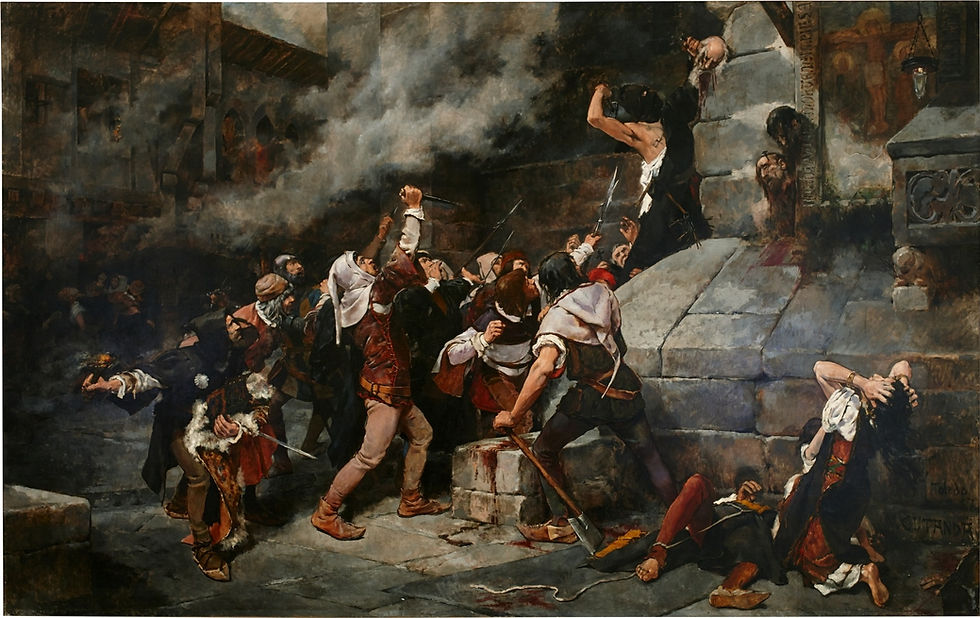
This catastrophe occurred a century before the expulsion decree of 1492. It would be historically careless to attribute the violence of 1391 to religious imagery alone. Economic rivalries, political instability, inflammatory preaching, local tensions, and the weakening of royal protection all require consideration.
Yet the scholarship of Espí Forcén raises an important question: what role did generations of hostile representations play in preparing Christian audiences to regard their Jewish neighbors as legitimate objects of suspicion or punishment? Images need not command violence directly to help create an atmosphere in which violence becomes conceivable.
The persecution of Jews was not the inevitable consequence of Christian religious belief, nor was hostility uniform across Christian society. Periods of cooperation, intellectual exchange, commercial partnership, and coexistence formed part of the same history. But coexistence did not prevent the gradual accumulation of stereotypes that could be activated during moments of crisis.
By 1492, when Ferdinand and Isabella ordered the expulsion of Jews who would not convert, the communities of the Iberian Peninsula had already experienced generations of discrimination, violence, and religious pressure.
The decree marked a decisive rupture, but it did not emerge from a historical vacuum.
A History That Did Not Begin in the Twentieth Century
There is another reason I have become interested in the work of Carlos Espí Forcén, one that reaches beyond medieval Spain.
When we speak of antisemitism today, we often begin with the Holocaust. Understandably so. The systematic murder of six million European Jews remains one of the most thoroughly documented crimes in human history.
Yet I wonder whether beginning the story there, without sufficiently exploring what preceded it, creates an unintended problem.
The Holocaust can appear to younger generations as an isolated catastrophe, an extraordinary episode of twentieth-century barbarism disconnected from the longer history of European civilization.
It was extraordinary in its methods, organization, and genocidal ambitions. But the hatred upon which it drew was not invented in the twentieth century.
For centuries, European societies had cultivated images of Jews as dangerous, treacherous, morally corrupt, or collectively responsible for crimes they had never committed. These accusations changed with the times. Medieval religious hostility was not identical to modern racial antisemitism, but certain inherited stereotypes proved remarkably adaptable.
The Holocaust did not emerge from a historical vacuum. Its historical reality is established by overwhelming documentary, physical, and testimonial evidence. Earlier persecutions are not needed to prove that it happened. What they offer is a deeper understanding of the long history of prejudice upon which modern antisemitism could draw.
To study the persecution of Jews across centuries is not to suggest that every episode was identical, or that the Holocaust was inevitable. It is to recognize recurring mechanisms: the invention of collective guilt, the circulation of false accusations, the identification of a minority as a threat, and the transformation of prejudice into social exclusion or state policy.
This longer perspective may also help us understand why denial and distortion are so dangerous.
When a historical catastrophe is presented without its antecedents, it becomes easier to imagine it as an inexplicable aberration, something that belongs entirely to another time and place. But when we examine the recurrence of anti-Jewish persecution, the history becomes more difficult to dismiss as an isolated episode.
The massacre of Jewish communities in 1391, the expulsion of 1492, the persecutions of subsequent centuries, and the Holocaust were distinct historical events, separated by different political systems, religious ideas, and social conditions. They should never be collapsed into a single narrative of inevitable suffering.
Nevertheless, studying them together reveals how prejudice can survive by changing its language, adapting its accusations, and finding new means of expression. Antisemitism was neither spontaneous nor inevitable. It was taught, repeated, institutionalized, and periodically transformed. And what societies have learned, they may also learn to question.

The Power of Images
Here lies a paradox that I find especially compelling as a filmmaker: If images once helped teach generations of Christians to fear and despise their Jewish neighbors, might images also help future generations understand how that hostility was constructed?
The medieval altarpiece, the illuminated manuscript, and the carved figure were among the powerful visual media of their time. They communicated ideas through familiar stories and recognizable symbols, often to audiences with limited access to written texts.
The same image could be encountered repeatedly, within a setting that conferred upon it religious authority.
Today, moving images occupy an equally significant place in our cultural experience.
Cinema, television, photography, and digital media shape our understanding of events we have not witnessed and people we have never met. They can perpetuate stereotypes, but they can also challenge them.
The relationship between historical images and contemporary visual culture is not merely technological. It concerns the authority we grant to what we see.
A painting in a medieval church might present a fictional accusation as sacred history. A manipulated photograph or misleading video can perform a comparable deception in our own time. The instruments have changed. The vulnerability of audiences to persuasive visual narratives has not disappeared. Yet the possibilities for education have also expanded.
Film can juxtapose the hostile imagery of the past with the historical record that exposes its falsehoods. It can restore names, faces, occupations, families, and individual experiences to communities too often represented through the imagination of their persecutors.
It can show a medieval image and ask not simply what it depicts, but who commissioned it, who encountered it, what purpose it served, and what consequences its message might have carried.
Such an approach does not require suppressing disturbing historical material. On the contrary, it requires examining that material with care, providing the context necessary to understand its origins and meaning.
The objective is not to replace one form of propaganda with another.
It is to cultivate the habit of looking critically.
Film cannot undo the past. Nor should it presume that historical understanding alone will eliminate prejudice. But it can make visible what has been forgotten, confront inherited stereotypes with evidence, and restore human individuality to communities too often reduced to symbols.
Perhaps the task is not simply to show what happened to the Jews of Spain, but to reveal how their neighbors were taught to see them. And, in doing so, to teach ourselves to look again.
What Remains
Returning to Plaza del Patriarca, I find myself thinking about the relationship between images and absence.
The medieval Church possessed an extraordinary visual language through which it could communicate religious doctrine to populations with limited access to written texts. Those images were not necessarily understood in identical ways by every viewer, but they helped shape the moral imagination of Christian society.
The Jewish communities of Spain possessed their own institutions, traditions, intellectual achievements, and forms of cultural expression. Much of that world was disrupted or destroyed through persecution, forced conversion, and expulsion.
What remains in Valencia is an uneven historical record: archival documents, archaeological traces, street patterns, and the work of historians attempting to reconstruct a community whose presence has largely disappeared from public view. The contrast is difficult to ignore.
Images that helped portray Jews as dangerous could survive for centuries in Christian religious settings, while the ordinary Jewish lives against which those suspicions were directed became increasingly difficult to recover.
But the history of Jewish Spain cannot be reduced to persecution alone.
For centuries, Jewish communities contributed to the intellectual, commercial, scientific, and cultural life of the Iberian Peninsula. Their history includes achievement, creativity, religious thought, family life, and the ordinary complexity of human existence.
To remember only their suffering would be to allow their persecutors to define them once again.
Perhaps this is one reason I find the subject so compelling.
As a Jew born in Argentina, shaped by decades of life in the United States, and now temporarily making my home in Valencia, I am discovering that history is not simply what a city preserves.
It is also what a city has learned to forget. And sometimes, to understand what has been forgotten, we must begin by looking very carefully at what remains.
References and Further Reading
Carlos Espí Forcén
Herederos de la culpa: antijudaísmo en la cultura visual hispánica de la Baja Edad Media. Doctoral dissertation, Universidad de Murcia, 2008.
Cristianos y judíos: imágenes instigadoras de asesinatos rituales y profanaciones de hostias en la Baja Edad Media. In La Multiculturalidad en las Artes y en la Arquitectura, 2006, pp. 637–644.
La recrucifixión de Cristo: imágenes antisemitas en la Baja Edad Media hispana. In La Multiculturalidad en las Artes y en la Arquitectura, 2006, pp. 325–330.
Érase un hombre a una nariz pegado: la fisiognomía del judío en la Baja Edad Media. Congreso Internacional Imagen y Apariencia, Universidad de Murcia, 2009.
Pilatos se lava las manos: la ambigüedad de la figura del prefecto romano en el arte y pensamiento medieval. Imafronte, no. 23 (2014), pp. 11–27.
Additional historical reference
Museu d’Història de València, Judería, historical overview of Valencia’s medieval Jewish quarter.


Comments