


New York’s Hidden Guastavino
Brooklyn, New York — Guastavino is most impressive when we can distinguish and appreciate his trademark footprint, his distinctive design. There is something almost physical about the exposed tile, the curves and the colors of the terracotta, occasionally glazed, as appears to be the case at the Boathouse in Prospect Park, Brooklyn. There is an old Mediterranean flair to it, one that has contributed greatly to defining a unique New York style of building interiors. At Ellis Island, Grand Central and many other places around New York, you don’t have to be told that Guastavino was there. You see it. But there is another Guastavino, one that was never intended to be seen.
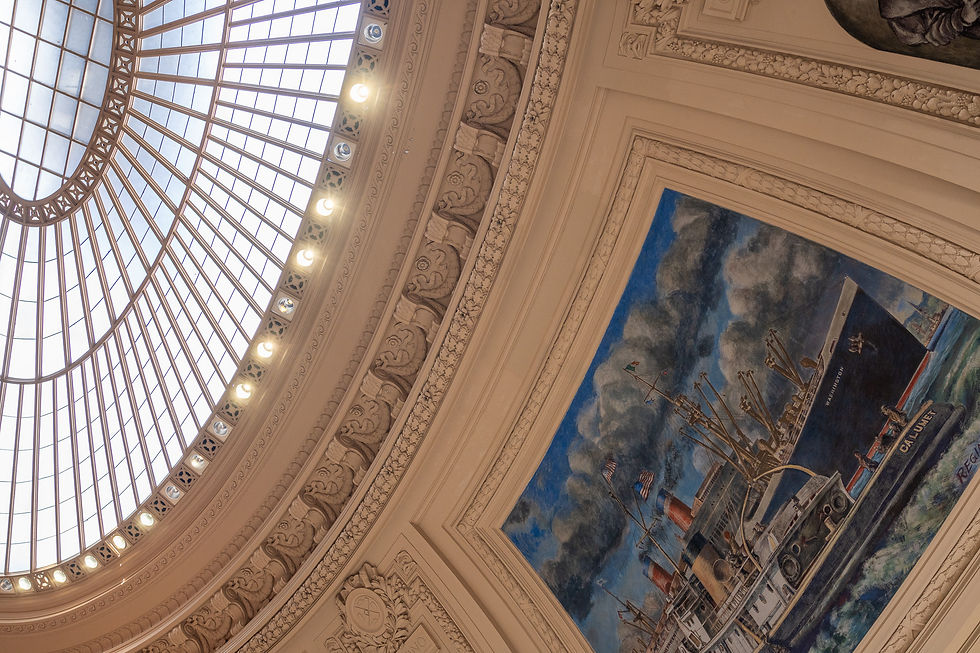
Yesterday, while scouting locations for Visions of Spain, I returned to the old U.S. Custom House at Bowling Green. I know the building very well, or at least I thought I did. I spent time there while making Daniel Chester French: American Sculptor, because the monumental figures representing the four continents were designed by French and carved by the Piccirilli brothers. Now I’m back for Guastavino. It often happens this way. I return to a building for one reason and discover something I had walked past, or underneath, many times before. Buildings never seem to finish telling their stories.
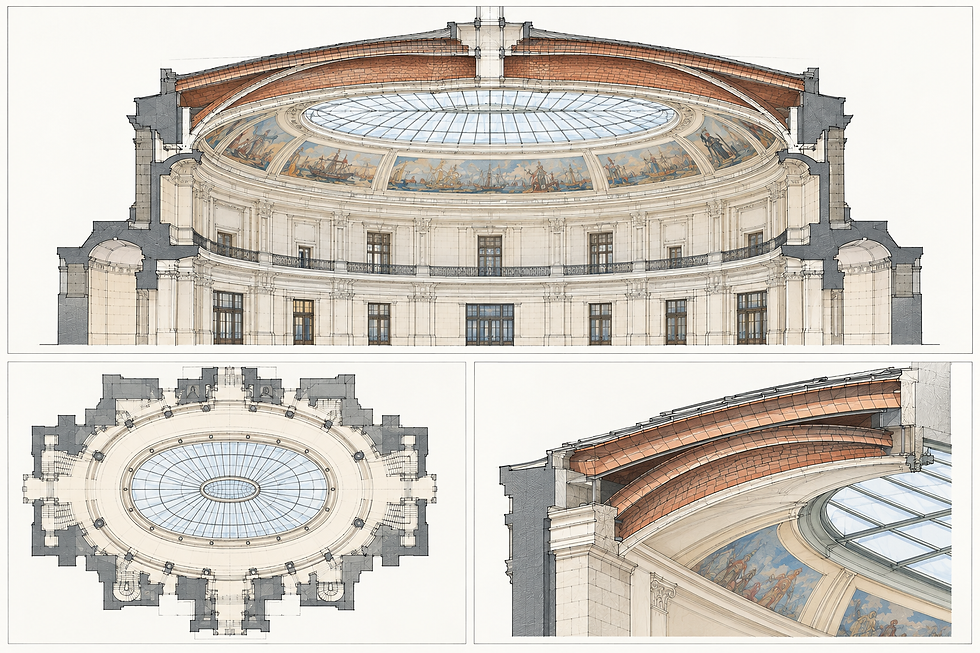
The great rotunda on the second floor of the U.S. Custom House presented Cass Gilbert’s office with a real problem. It is an enormous elliptical space, and they needed someone who could make the ceiling work structurally and make it fireproof. This was not a commission for the exposed tilework that today makes Guastavino so immediately recognizable. They needed his system, his understanding of tile vaulting and his ability to adapt it to Gilbert’s ellipse.

That is precisely what the Guastavino team was called upon to do. Above the finished room is a system of thin tile shells following the elliptical form, while the interior seen from below was finished in plaster and decoration. The tiles were not the show. Later, Reginald Marsh painted his maritime murals around the great central skylight, adding yet another layer to the room. I’m not ruling out coming back a fourth time. I could hardly resist a commission to document Reginald Marsh on film, and there is enough in this building alone to justify the return.
Perhaps that is why I had never really thought about this as a Guastavino building. Guastavino remained behind all of it. We have become accustomed to recognizing him through the terracotta itself. We see those familiar tiles and immediately say Guastavino. But what happens when the tiles disappear? His work is still there, holding the ceiling above us, only now we have to know where to look.

I had encountered something similar much closer to home, at the University of Virginia. After the fire of 1895, Guastavino participated in the reconstruction of Jefferson’s Rotunda. There, too, he entered a building with an architectural identity that already belonged to somebody else. Nobody was going to turn Jefferson’s Rotunda into a Guastavino showcase. His contribution had to solve a problem and then, in a sense, get out of the way.
So I find myself once again at Bowling Green, in a building I have visited many times, only now looking at it differently. First I came for Daniel Chester French and the Piccirillis. This time I came looking for the Valencian who had been hiding above my head all along. Perhaps that is one of the reasons I keep returning to these places. It isn’t only that there is always more to learn. Sometimes what changes is simply what we have learned to see.


Comments