


Shakespeare Can't Swim!
Updated: May 4
Last night, Jessie Buckley won the Academy Award for Best Actress for her extraordinary performance as Agnes Hathaway — Shakespeare's wife — in Chloé Zhao's Hamnet. A deserved, long-anticipated win, and if you haven't seen the film yet, stop reading this and go watch it immediately. I'll wait.
To Rufus Collins
Still here? Good. Because I need to tell you about the moment Hamnet broke my concentration — not because of anything Buckley did, but because of something Shakespeare did. Specifically, something Shakespeare did in a lake.
Soledad and I were watching Netflix at home. It was one of those evenings where the couch is comfortable, the film has you completely in its grip, and everything is going well. Then Shakespeare — Paul Mescal's brooding, tormented, magnificent Shakespeare — jumped into a pond and swam the crawl. The crawl?
"Pause it!" I said.
Soledad looked at me the way only a partner of many years can. Patient. Resigned. Faintly murderous.
"Did Shakespeare just swim the front crawl?"
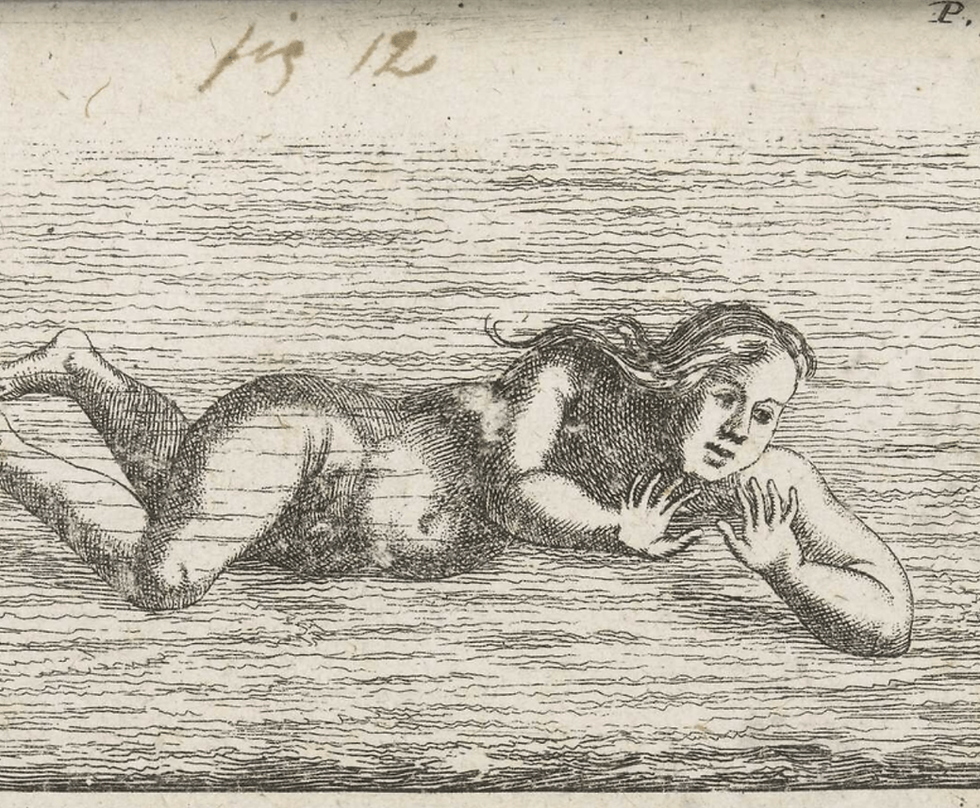
She did not answer. Ignoring my plea for clarification, she resumed the film. I, however, could not let it go — because what I had just witnessed was one of cinema's more charming anachronisms. Shakespeare lived from 1564 to 1616. The front crawl — the overarm, alternating, face-in-the-water stroke that Mescal's Will deployed with such effortless Elizabethan grace — would not reach England for another two and a half centuries. To be precise: not until 1844, when two Ojibwe men from Canada came to London and left the British swimming establishment in a state of scandalized confusion.
I should say that I understand why filmmakers do this. We dress characters in historically approximate costumes, we give them psychologies shaped by centuries of subsequent thinking, we let them speak in cadences that no Elizabethan ever used. Cinema is interpretation, not reenactment. Chloé Zhao has earned the right to take whatever liberties she pleases. And the film is, without question, ravishing.
But the swimming nagged at me. Because the real history of how that stroke arrived in England is, improbably, one of the more fascinating stories in the history of sport — and it says something pointed about European cultural arrogance that feels entirely relevant to our moment.
Here is what actually happened.
In 1844, two Anishinaabe men — Wenishkaweabee (Flying Gull) and Sahma (Tobacco) — were invited by the British Swimming Society to give an exhibition at the swimming baths in High Holborn, London. They were part of a larger troupe of nine Ojibwe who had traveled to England with the American painter George Catlin, who had become a passionate admirer of Indigenous swimming technique after his own brother drowned, and who had spent years documenting Native American life along the Missouri River.

At the signal, Flying Gull and Tobacco dove in. The British spectators were horrified. The Times of London reported with evident disgust that the swimmers "thrashed the water violently with their arms, like sails on a windmill, and beat downward with their feet, blowing with force and forming grotesque antics." The stroke was declared "totally un-European." Flying Gull won the race — 130 feet in 30 seconds — and was awarded a silver medal. Then the British went home and continued swimming breaststroke for the next three decades.
The irony, of course, is that this stroke was not new. It was not an exotic curiosity. It was, in various forms, ancient. American colonists had been watching Native Americans swim the overarm stroke since at least the early 1700s. A Virginia planter named William Byrd wrote in his journal in 1733 that a Native American companion taught his group to swim by striking alternately with each arm rather than together, and noted they could go both farther and faster. Similar techniques had been documented among Atlantic African swimmers, Pacific Island peoples, and in Egyptian tomb paintings going back four thousand years. The front crawl is probably as old as human beings in water. The breaststroke — calm, dignified, head held above the surface — was the aberration, the cultural affectation, the thing that needed explaining.

None of this mattered to Victorian England. The crawl was splashy. It was energetic. It was, most damningly, un-European.
It took until 1873 for an English swimmer named John Trudgen to introduce an overarm stroke to competitive swimming — and the story has a Buenos Aires connection. Trudgen had arrived in the city as a boy of eleven, his father brought over by a British engineering firm, and it was there that he first watched local children cutting through the water with an overarm action unlike anything he had seen back home. He later deepened that knowledge working among the Guaraní people in Paraguay, and when he finally raced at Lambeth Baths in London in 1873, he caused a sensation. He modified the stroke with a scissors kick — the flutter kick that Flying Gull had used a generation earlier was still deemed too undignified for proper competition. By the early 1900s, Australian swimmer Richmond Cavill, having watched a boy from the Solomon Islands swim at Bronte Beach, finally developed what became known as the Australian Crawl — the direct ancestor of the stroke Paul Mescal used in that lake in Hamlet.
The portraits of Flying Gull and Tobacco, painted in London in 1844 by the sisters Fanny and Louisa Corbaux, survive. Flying Gull's watercolor hangs in the Gilcrease Museum in Tulsa. Two men who crossed an ocean, demonstrated a technique that would come to dominate competitive swimming worldwide, were dismissed as barbaric — and then largely forgotten, while the history was quietly reassigned to others.
So: Shakespeare could not swim the crawl. That stroke, in England, belonged to two Ojibwe men who arrived 228 years after his death, dove into a pool in High Holborn, and were told they were doing it wrong.
Soledad, as always, was right to resume the film. But I maintain that the anachronism interrupted my attention first.


Comments