


James Monroe's Farm During the Reign of Terror, Cradle of the University of Virginia
Updated: May 24
There is a strange asymmetry at the heart of Monroe Hill. The hill bears the name of a man who, during the decade he owned it, was rarely there. James Monroe purchased the property in 1789, the year the Bastille fell. He sold it in 1799, the year the Directory collapsed and Bonaparte seized power. The arc of his ownership maps, almost to the month, onto the arc of the French Revolution — and the decade he held the farm was the decade he spent, in mind and increasingly in body, in Paris. That asymmetry is what I set out to film, and what I keep finding more of, ten years after the cameras went down.
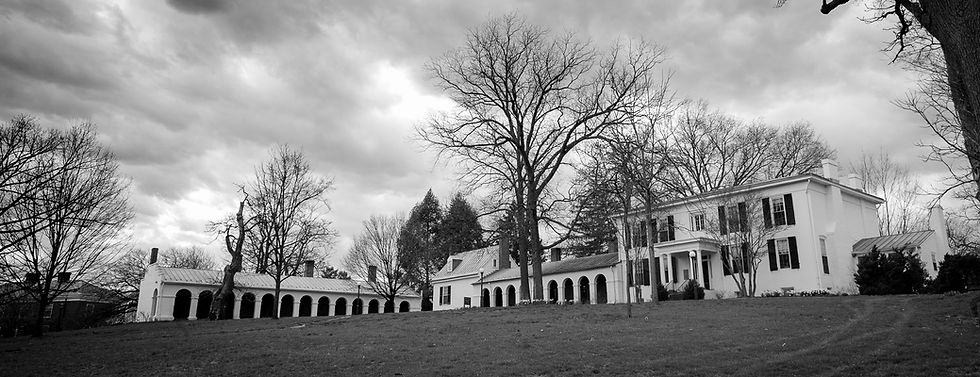
When I made Monroe Hill in 2015 — with the extraordinary support of an award from the Jefferson Trust, in collaboration with Brown Residential College, the School of Education, Ash Lawn-Highland, and the Presidential Precinct — I was working from a transcript that kept circling back to that absence. Soledad Liendo produced the film. I wrote and shot it. The principal consultants and historians — Daniel Preston, Sara Bon-Harper, Benjamin Ford, William Ferraro, Scott Harris, Kat Imhoff, Louis Nelson, Kyle Edwards, Carl O. Trindle, Erik Midelfort, Anne McKeithen, and Richard Guy Wilson — kept guiding me to the same paradox: the man whose name the hill carries was, for most of the years he held it, somewhere else.
The standard biographical narrative wants to tell us that Monroe came to Charlottesville to be a Virginia gentleman, a neighbor to Jefferson and Madison, a cradle figure of the new American Republic. That is true, but only in part. By the time he had cleared his orchards and taken out his first insurance policy on the brick law office that still stands on Grounds, Monroe was already in Philadelphia, sworn in as a United States Senator at the close of December 1790. By the summer of 1794, with Robespierre's head still warm in the basket, he was on a ship to France as Minister Plenipotentiary. He arrived in Paris one week after the Ninth of Thermidor.

Paris, and the Farm in Distress
The Paris years are what I keep returning to. They are the dramatic core of the film, but more than that: they are the years that make sense of the hill itself. Monroe and Elizabeth lived at La Folie Bouëxière — an elegant residence on the Rue de Clichy, with a view of the slope where Sacré-Cœur would one day rise — and that house functioned as something halfway between an embassy and a sanctuary. Thomas Paine, freshly released from Luxembourg Prison, wrote the second part of The Age of Reason under Monroe's roof, along with the pamphlets denouncing Washington that would so wound the President when he read them. Wolfe Tone passed through, bridging the Society of United Irishmen and the French government in the connections that would lead to the three failed invasions of Ireland. And in one of the most consequential single acts of any American minister abroad, Elizabeth Monroe — by means of a calculated public visit — secured the release from the guillotine of Adrienne de Lafayette.
While all of this unfolded on the Rue de Clichy, Monroe Hill was a farm in distress. The letters between Monroe and his uncle Joseph Jones, between Monroe and Madison, between Monroe and a series of unreliable overseers — his brother Joseph chief among them — do not read like the correspondence of a master in command. They read like the correspondence of a man trying to hold a property together by post: instructions about peach orchards, queries about whether to add a wing to the house, anxieties about what to plant, what to sell, whom to trust. At one point, he was openly trying to unload the farm at any price.
The labor of Monroe Hill, meanwhile, was not Monroe's. It was Thenia's, and Peter's, and that of the eleven other adults and one child, the 1797 property tax records list as enslaved on the hill. Thenia Hemings — the older sister of Sally — had been sold to Monroe by his uncle, along with her daughters Betsy, Lucy, Mary, Sally, and Susan. Peter, the gardener, was almost certainly her partner. They lived and worked the property while its owner was crossing the Atlantic, attending the National Convention, dining with Paine, drafting dispatches. Thenia gave birth to a sixth child in the winter of 1795. She died a year later, on a hill she had not chosen, in a country whose first principles her owner was busy explaining to the French. Monroe, in Paris, would have learned by letter, weeks after the fact. We believe she lies in the African American cemetery recently reconsecrated on Grounds — within the boundaries of what was once the property of an absent owner.
This is what the film, in its quiet way, tries to honor. The camera lingers on the brick law office, on the surviving structure at Limestone, on the fields that once were planted and are now lawn. The polyphony of voices argues across the decades. D.W. Griffith's America and Orphans of the Storm furnish the only flickering visual record of a Revolution whose actors were dust before the camera was invented. It is the only way I know to film a man who is barely there.
The Long Way Home
Monroe was recalled in 1796. The crossing was rough. He wintered in the Netherlands, sailed from Bordeaux in the spring, and was met at the dock in Philadelphia by Jefferson, Madison, and Albert Gallatin, who knew what the rest of the country would not yet admit: that he had been blamed for a rupture he had in fact prevented. The Federalists called his return a disgrace.
Hamilton accosted him in New York over the Reynolds Affair leaks; the two nearly fought a duel. Monroe published his View of the Conduct of the Executive, a full-scale assault on Washington's foreign policy, and broke permanently with the first president. Then, finally, he came home. By the close of 1799, he was governor of Virginia. The hill was sold. He moved his family to Highland.
Monroe's relationship with Paris did not, in any case, end with his recall. He returned in 1803 to help Robert Livingston close the Louisiana Purchase, and again in December 1804, by then Minister to Britain, to attend the coronation of Napoleon at Notre-Dame. Napoleon, displeased with the United States over the Spanish Floridas, had Monroe and Elizabeth seated in the gallery — "a great measure out of sight," Monroe wrote, "and not with those in our grade, the Foreign Ministers." Rumor has long held that he is depicted somewhere in Jacques-Louis David's Sacre de Napoléon, the colossal canvas now in the Louvre. The leading David scholar, Philippe Bordes, has said he has never seen evidence of it. But David painted figures who were not present — Napoleon's mother, chief among them — and a man as practiced as Monroe in the diplomacy of being almost-there could plausibly be hidden in plain sight in a corner of the gallery, the absent landlord once again barely in the frame.
The Cornerstone
Eighteen years after he sold the hill, on October 6, 1817, Monroe stood again on the same ground. He was now President of the United States. He was a member of the Board of Visitors of a university not yet built. Jefferson handed him a trowel, and he laid the cornerstone of what would become the University of Virginia, a perfect square of stone set into a turned-out old field. From the spot where he stood, he could look up the slope and see his own red brick law office still standing on the hill — the building that predates everything else on Grounds, the oldest structure at UVA. The farm that had failed him as agriculture would succeed him as a foundation. The seed he had not been able to plant in tobacco or wheat would, in his absence, become a university.
I am writing this in the spring of 2026, the year of the United States Semiquincentennial — the 250th anniversary of the Declaration of Independence — and a few months out from the next observance, on October 6, of the cornerstone laid on the hill. The two anniversaries fold into one another in a way that speaks directly to the argument of the film. Monroe is not Jefferson. The hill is not Monticello. He had no estate to which posterity could affix a halo. What he had instead was a decade of revolutionary diplomacy conducted from a small Parisian mansion on the Rue de Clichy, a farm worked by people whose names we are only now recovering, and a single moment in 1817 when, at the end of a long and strange life, the absent landlord came back to lay the stone that justified everything.
Eliza
There is one more thing — a note that did not make it into the film, because it didn't belong in the film, but which has belonged to me ever since. While in Paris during the research, tracing Monroe's footsteps from the Rue de Clichy outward, I went looking for the grave of his eldest daughter. Elizabeth Kortright Monroe Hay — Eliza, as she was always called — had died in Paris in January 1840, on a return visit to the city where she had grown up. As a child during her father's ministry, she had attended the Maison d'éducation de la Légion d'honneur and become a friend of Hortense de Beauharnais, the future mother of Napoleon III. She had come back to Paris, in the end, to die there. She was buried at Père Lachaise — not Montparnasse, as I had half-remembered — in Division 40, in what is sometimes still called the American section, on a slope where the lesser figures of the Empire she had glimpsed as a girl had also been laid. Her grave was unmarked, neglected, half-swallowed by ivy. I stood there for a while and thought what I have often thought in cemeteries: that history has a way of telling a story better than we do.
This past October, Eliza was repatriated — though to my mind it was an absurd caprice to disturb her at all. She had lain at Père Lachaise for 185 years, in a section of the cemetery where, a few rows over, Jim Morrison receives his daily quota of pilgrims and graffiti. I rather liked the idea of Eliza and Jim as neighbors. The State of Virginia and the Diocese of Richmond thought otherwise. They organized a reinterment at Hollywood Cemetery, beside her father's tomb, with a memorial mass at the Cathedral of the Sacred Heart and a Rite of Committal at the graveside, the whole production resting on the late and well-documented fact of Eliza's conversion to Catholicism — a fact the Diocese rode for everything it was worth. The ceremony was not a return of a forgotten daughter so much as a hijacking of her, by the Church on one side and by the present-day custodians of the Monroe legacy on the other. I went. I watched part of it. I left. Père Lachaise had told me a quieter and, I think, truer story — one in which the eldest daughter of an absent landlord lay in an unmarked grave on a foreign hill, exactly where the larger logic of her family had always placed her: just outside the frame, and a few paces from the Lizard King.
The film was dedicated to the memory of Kurt Hilburger, the fourth-year archaeology and anthropology student who drove me through Albemarle for months and died, weeks before the premiere, in a car accident he should have walked away from.
Monroe Hill premiered at the Virginia Film Festival in November 2015 and on PBS the following spring.
It is, I think, the right film for this year — for a country reckoning with its 250th, and for a university about to mark another anniversary of the stone Monroe laid in the field he had once failed to plant.

Comments