


The Lakota Music Project: A Circle Big Enough for Reconciliation
Updated: Apr 12

Horowitz (Joe) mentioned it in passing, the way he often does with things that matter — without fanfare, almost as a question. We had just finished work on Life and Music in the Age of George Frederick Bristow, a film that had taken us deep into the contested, largely forgotten terrain of 19th-century American music, and Joe was already thinking ahead. Had I heard of Delta David Gier and the Lakota Music Project? I had not. But something in the way he said it told me I should.
I went home and started reading, and within an hour I was somewhere else entirely — not in South Dakota, but in Buenos Aires, in the early 1970s, watching my father prepare for what would become the Serie del Conocimiento, a landmark collection published by Qualiton that remains, half a century later, one of the most serious attempts ever made to document the living musical heritage of Argentina and its indigenous peoples. He did not go into the field himself — he was not that kind of man. He gathered the scholars, the musicologists, the sound recordists, and sent them into the Argentine northwest, the Gran Chaco, the Pampas. He understood that this work needed to be done, that someone had to conceive it and fight for it and see it through, and that the someone was him.
The collection grew into six LPs of field recordings — charango, caja, bombo, the aerófonos of the northwest, accordion, violin, guitar — and then a sixth record that stands apart from the rest: Música de los Aborígenes, introducing the sounds of the Toba, Mataco, Chorotis, Chiriguano, and Ranquel peoples. The set came with a book in Spanish, French, and English, 36 color slides, a hand viewer, illustrations, index, and bibliography. Frank Gillis, Associate Director at the Archive of Traditional Music at Indiana University, called the recordings authentic and of high quality. The Fondo Nacional de las Artes purchased the entire first edition. It won first prize at the Sexto Festival del Disco Internacional in Mar del Plata in 1967.

My father believed that these sounds — recorded in places most people would never visit, belonged to everyone. That the act of listening was itself a form of respect. That documentation was not extraction but preservation, and that preservation was a political act, whether you called it that or not.
I did not fully understand this as a child. I understand it now. Which is why, when I read about Delta David Gier and what he has been building in South Dakota for the past twenty years, I felt something shift.
Gier is the music director of the South Dakota Symphony Orchestra. But that title barely begins to describe what he has done. In 2004, he walked into Lakota country with an idea and was met, quite reasonably, with skepticism and distrust. What did a symphony orchestra have to offer communities that had spent generations watching their culture diminished, appropriated, or ignored? The answer, it turned out, was not a program, not a grant, not a gesture — but time. Patience.
What emerged is the Lakota Music Project — a collaboration between the South Dakota Symphony Orchestra and Lakota and Dakota musicians that is unlike anything else in American cultural life. This is not a guest-spot model, where an indigenous artist appears on stage for a movement and then disappears. The LMP commissions original works, brings orchestral musicians and tribal artists together as equals, and performs them side by side — in community centers on the Pine Ridge and Rosebud and Crow Creek reservations, and at the National Cathedral in Washington, D.C. In 2025, the Shared Vision Tour reached more than 10,000 people across South Dakota's reservations. New works by composers Derek Bermel and Jeffrey Paul received their world premieres at the Crazy Horse Memorial.

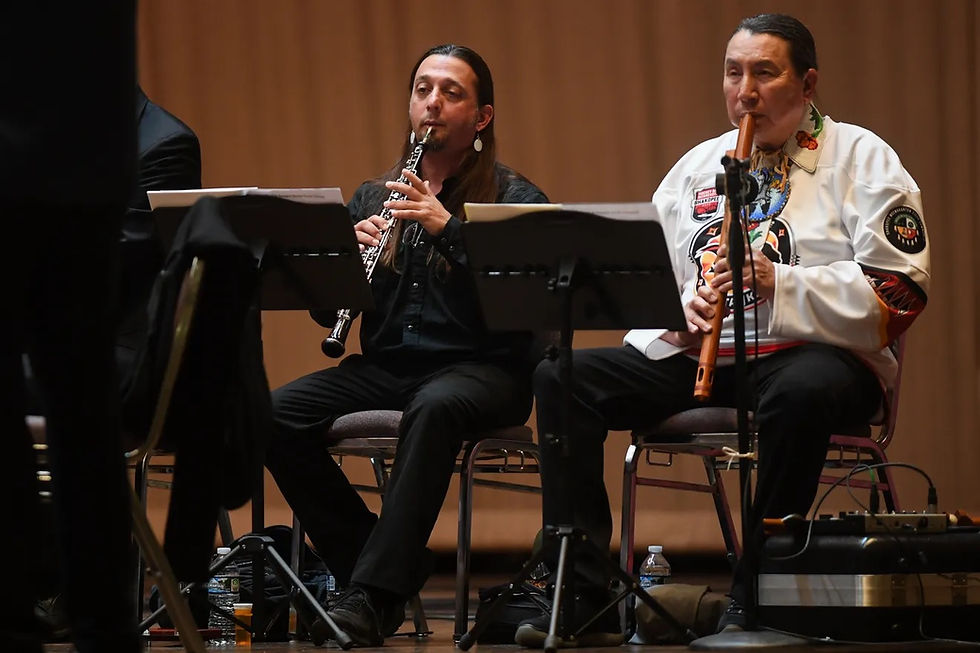
Emmanuel Black Bear, drum keeper of the Creekside Singers, describes the collaboration as erasing a line and drawing a circle big enough for reconciliation. Bryan Akipa, a Dakota cedar flutist and one of the project's primary artistic voices, has been part of that circle from near the beginning. Composers like Jerod Impichchaachaaha' Tate and Brent Michael Davids have written works that do not ask either tradition to subordinate itself to the other — but to listen, and then to play.
I am a filmmaker. I do not accept commissions lightly, and I do not take on subjects that do not find me as much as I find them. But I am thinking seriously about this one.
What draws me is not the story of a well-meaning conductor, though Gier is clearly extraordinary. What draws me is the question underneath it — the same question my father was asking when he sent his team into the Argentine Chaco in 1975 with microphones and notebooks: what does it mean to truly hear music that was made without you in mind? What changes in you when you do?
My father documented those sounds so they would not be lost. Gier is doing something harder — he is asking what happens when two musical worlds stop being documented and start being lived together. That is a different kind of project. It may be a different kind of film.
I am still listening.
If this conversation is one you want to continue, subscribe to the blog at MontesBradley.com and follow the work as it unfolds.



Comments